Please note that all physical purchases on the site are restricted to UK delivery only. This does not apply to digital downloads like manuals which are available globally. Dismiss
Olympus OM-1 Review – Giant Killer: – As 1972 arrived the four giants of the Japanese film camera business were doubtless feeling rather smug. Nikon, Canon, Pentax and Minolta were probably rubbing their hands with glee and dreaming of the sound of the soft rustle of money falling into their bank accounts. Nikon after all had just released their F2 in 1971 and had upped the ante from their world beating Nikon F. They were probably feeling rather pleased with themselves. Canon likewise had unveiled their F1 with which they hoped to capture the pros away from Nikon. Minolta were on the cusp of releasing their all electronic marvel the X1 and likewise were hoping to drag some pros away from Nikon. Pentax were probably looking a bit glum to be fair with not much to show beyond a rehash of their venerable Spotmatic the Spotmatic IIa, but then Pentax had been steadily losing ground almost from the moment they perfected the 35mm SLR concept. The other three though were doubtless felling rather chuffed as they chomped into their breakfasts and lunches and calculated on a good few years of nice fat profits from their latest offerings.
But, over in a dark corner, out of sight, a newcomer was lurking in the shadows. It would be small but deadly! In a few short years it would kill off some camera developments entirely, redefine what a 35mm SLR should be and change the market for a long while to come. Developed by one of the most inventive of designers and launched from a company hitherto almost unknown in the world of professional photography it would change everything – Cry havoc and let slip the Olympus OM-1!
The OM-1 arrives
Technically it was the M1 that arrived. Olympus originally called it the M1 and it launched at the Photokina Show in Cologne in 1972. Leica were most unhappy as their cameras were always called ‘M Something’ and after a bit of corporate wheeler dealing Olympus agreed to change the name to OM-1. Leica were somewhat mollified when Olympus agreed that the M1 designated units would not be sold outside of Japan. M1 units accounted for around 52,00 units and while collectible are not in fact the best of the Olympus OM-1 series as Olympus made quite a few changes after early production.
Leica were no more than a nuisance as Olympus would go on to sell around 1.3 million OM-1s where Leica would be hard pressed to sell 50,000 of anything in the same time frame.
So what made the camera so upsetting and unsettling to the industry? In a word size – but it also had some other attributes too.
The biggest shock to the market was how small the OM-1 was, in an age of cameras that had steadily bloated in size the OM-1 looked positively toy like. Its diminutive size gave many pause for thought fearing such a small camera may well be unreliable but the OM-1 had been well designed, why would you expect less from Yoshihisa Maitani a true design genius. The OM-1 handled superbly and it featured an exceptionally wide field of view through its viewfinder which was also exceptionally bright. The camera was released with a massive selection of lenses and accessories which grew over time to create one of the most complete SLR camera systems.
Olympus OM-1 Review:- An Olympus OM-1 sizes up to a Nikon F typical for a pro camera in the 1970s.
Olympus OM-1 Review:- From the top the OM-1 looks tiny compared to the bulk of a Nikon F or F2.
The small size was the result of Maitani-san reconsidering the internal layout of the camera to create a 35mm SLR that was closer in size to a Rangefinder type. This radically different layout though had some downsides as you’ll see later.
Strangely for all the radical reduction in size the OM-1 is quite basic as a camera. There are few techno twirls, the camera is a fully manual system using batteries only for its light meter. Beyond its small size it is a relatively simple mechanical beast albeit one with very nice handling. Simple and straightforward to work with and in many ways maybe the best mechanical camera of its day for the working photographer and much used by David Bailey among others.
Refining the OM-1
On release the OM-1 could not support a motor drive. Olympus finally added a motor drive capability with the OM-1 MD which also included other manufacturing tweaks to get the camera ‘right’ internally and get over problems which had appeared in the earlier version. This is why I said that the M1 model while collectable is probably not the best example to shoot with.
In 1979 Olympus further refined the camera with the release of the OM-1n which featured further internal improvements plus a flash ready indicator and automatic X sync flash when used with its Flash Shoe 4 fitting. One of the interesting design choices with the OM-1 camera was the fact that it had a removable flash shoe. Modern shooters find these break with monotonous regularity. They were fragile even back in the 1970s and the plastic hasn’t gotten any stronger since.
Camera snobs will always claim the earlier version was the best. I have shot both the OM-1 MD and the OM-1n and found absolutely no difference in them at all.
Olympus OM-1 Review:- One of my very battered OM-1n bodies showing the MD plate. The OM-1n was the final iteration of the OM-1 model and maybe the best.
Olympus OM-1 Review:- The cavernous OM mount throat. Actually it’s smaller than a Canon FD mount but the small body small size gives the mount a much larger look.
Using the OM-1 back then…
I graduated to the OM-1 MD via a trusty Pentax Spotmatic. I managed to bag one after a shot I got paid handsomely for allowed me to buy a more upmarket camera. The OM-1 was greatly desired in its day especially by younger photographers like me who kind of liked the kick to the pants that Olympus had delivered to more established makers and young people back then, just as now, could be somewhat swayed by the new and fashionable. In any event Nikon pricing for its F and F2 models pushed those cameras firmly out of the reach of any but professionals and people happy to live on cat food as the price of owning one. As soon as the cheque from my Pulitzer prize winning photo arrived (It wasn’t really a Pulitzer winner but the local paper was happy to pay over the odds for it) I was off to my local camera shop as fast as my kitten heels could carry me and the money swiftly transferred from my sweaty palms into the camera shops bank account. I walked out with a black OM-1, 55mm f1.2 lens and a very smug look on my face.
The camera was all I had hoped for – in fact the OM-1 was a revelation especially the view through the viewfinder which, after the Spotmatic, seemed incredibly bright and so expansive it was almost frightening. Even today the OM-1 viewfinder is not bettered for its widescreen like view although cameras like the Minolta XD can beat it on brightness.
The OM-1s minimalistic viewfinder. Just a simple meter needle and a very wide view.
Over time I acquired more lenses and a second body and did a lot of shooting with the OM-1. It was always solid and reliable and most other people back then who owned one found the same and its reliability was perfect despite many peoples fears over its small size.
I owned the OM-1 for a long time and it took thousands of pictures without fault. I grew to love its simple metering and even the oddity of its shutter speed control being wrapped around the lens worked well for me. Some people are still moaning about this unusual feature 50 years after the camera ceased production.
Olympus OM-1 Review:- The OM-1 shutter speed control is a ring around the base of the lens mount. Still annoying people 50 years later!
Olympus OM-1 Review:- Clean and simple top deck. The rotary control is for ASA setting. Simple on/off switch for the meter to the left.
One of the things I most loved with the OM-1 was its simplistic approach to stuff. As I pulled the camera to my eye I got used to flipping the meter on via its switch on the top cover, pulling the camera to my eye while getting my left hand gripping the shutter speed control so the camera would fall into my hands ready for shooting in seconds. The other oddity with the OM-1 was its depth of field stop down was managed via the lens rather than the camera body. The positioning of the stop down button on the lenses though was good and made for easy handling as it falls under your middle finger when gripping a lens. I was though always less keen on the lens f stop ring being towards the front of the lens which could create the odd fumble and again its something some people found annoying back then and still do today.
There’s no shutter safety on the OM-1. The design was based for pros and a pro would rather lose a frame than miss a shot! This can irk the amateur shooter in the modern day especially if they have a scrooge like approach to film.
Using the OM-1 now…
Time has not been kind to the OM-1. When I restarted film photography my first choice was another OM-1 to relive my salad days. A friend of mine who had two OM-1s out of use at her observatory where they had been used for many years for astro-imaging passed me two black OM-1n bodies in exchange for some of my home made jam (jam making is my other big hobby).
Olympus OM-1 Review:- My two OM-1n models rescued and serviced ready for shooting.
Sadly time has been even less kind to the OM-1 than it has been to me. While the camera still has a place in my heart some of the design and production choices have come home to roost. The biggest issue the OM-1 can have these days is decaying prisms caused by the foam Olympus installed on the prism top. This is probably the single biggest killer of OM-1 bodies but it’s not the sole issue though it’s usually the easiest to fix at least as far as removing the foam is concerned, a ruined prism can only be solved with a spare prism.
Many OM-1s suffer advance issues due to a spring in the base of the camera weakening and this is a more serious issue. There are no spares short of a donor camera and a weakened spring will cause the camera to keep jamming as you wind on. The final issue that afflicts the OM-1 is the decision by the design team to place the cameras high speed escapement in the base of the camera below the mirror box. This was the big change that allowed the size reduction but it has consequences. The high speed cams need to be clean and placing them in the lowest part of the camera where they are subject to dust and dirt ingress is the cause of many OM-1s having poor shutter performance today..
The cause of many OM camera jams – the very weak spring located under the gear indicated.
One of the weakest parts of the design even back in its day, although mine never suffered from it, is the hinge side light seal. The camera is known as a leaky camera from this seal today and old school techs tell me it were ever so with the OM-1. To get the seal right requires a relatively complex seal – this is covered in the light seal guide I wrote some time ago along with the very tricky mirror bumpers.
Both of my OM-1ns were serviced as both were suffering the advance jamming issue mentioned on arrival. After servicing they shot well and I have used them extensively over the past few years. I still think the OM-1 viewfinder is marvellous and personally always think the metering system of having a simple needle indicator is the best and simplest and doesn’t impinge on the view of the subject as much as many metering systems. It’s simple and clear and allows you to gauge exposure with the least fuss.
Negative Space, Kos – Olympus OM-1, 50mm f1.8 lens with deep red filter and Ilford FP4
Ancient Theatre,Kos – Olympus OM-1, 50mm f1.8 lens with yellow filter and Ilford FP4
Street Performers,Monschau – Olympus OM-1, 38-100 Tamron Zoom with Agfa APX400
Abandoned Factory,Solingen – Olympus OM-1, 28mm f2.8 lens using Kosmo Films Agent Shadow 400
I still love the OM-1 as an overall experience but have decided, reluctantly, to part with my two in favour of other cameras. In part this was down to lens choices. Olympus glass is good but relatively expensive for the top end glass. I chose to use my Minolta XDs which provide a similar size but are significantly more advanced than the OM-1 and Minolta glass, in my opinion, aces Olympus glass and it’s a lot less expensive even for exotic lenses.
What Olympus did next…
The OM-1 spawned a whole generation of OM cameras. Few would achieve the success of the original OM-1 design though.
In 1975 Olympus released the OM-2 in response to the rise of automatic exposure cameras pioneered by other manufacturers notably Minolta. The OM-2 operates just like an OM-1 with the addition of aperture priority automatic mode and a more sophisticated metering system which measured light off the film itself.
In 1983 Olympus reengineered the camera again and released the OM-4 with multi spot metering and an electronically controlled shutter. This was the high point of the OM camera evolution and the most sophisticated OM of them all but by 1984 Olympus were losing traction. Subsequent OM bodies were pitched towards an increasingly smaller market like the later OM-4Ti released in 1997 which was aimed at the upmarket shooter with a healthy bank balance. Essentially an OM-4 with titanium top and bottom plates. I owned one when new based on a desire to own another OM (I was at that time still besotted by the OM-1). It was a horror for reliability, constant transport failures and metering issues. In the end it went back for a refund and any brand loyalty I felt for Olympus was quashed forever.
The OM-3 and OM-2 Spot Program appeared in 1984. The OM-2 SP was basically a reengineered OM-4 to get the price of the OM-4 down while the OM-3 was basically an OM-1 with spot metering capability but retaining an all mechanical shutter so the camera could operate without batteries if required. These cameras had a very short production life of a few years. The OM-3 for instance was in production for a scant 3 years. Buyers preferred the less expensive OM-1 which was still in production.
The final true OM camera was the OM-3Ti released in 1995 – basically an OM-3 with titanium top and bottom plates, effectively a re-release of the OM-3. The OM-3Ti came with a very hefty price tag (circa £2,000 in 1999) aimed at the retro photographer, who being tired by the gimmickry then extant in the market just wanted a simple, solid, mechanical camera.
This fall from volume was a consequence of Olympus being forced into smaller and smaller market spaces for old school photographers due to the lack of any developments in Autofocus. The later OMs sold in very small quantities, the OM-3Ti was the last of the OM family on the shelf and production stopped in 2002 after a few thousand units.
This is the end…
The OM-1 was a fine camera in its day, it radically altered the camera market and forced rival manufacturers into different directions and place a premium on size and handling. It was a giant killer both in the effect it had on other companies but more so in it killing off a great many camera designs. Minoltas XE series for instance was a casualty. In time other companies fought back hard. Canon took a different approach entirely and went for low cost with their AE-1, Nikon eventually responded with the FM, Minolta punched back hard with the XD (almost the same size as an OM-1 but brimming with features) and Pentax would play Olympus at their own game of a small , wholly mechanical SLR in their marvellous MX.
Olympus had redefined the market but seemed unable to fully capitalise on it in much the same way as Pentax had created the 35mm SLR market and were then outflanked and outdistanced by others.
Looking back its quite surprising that the OM-1 had such an effect. It is at heart a relatively simple all mechanical camera with no gimmicks and that had a great appeal to many professionals in its day and continues to appeal to many modern film shooters. However it’s not a technical marvel and was, as things happened, rapidly outplayed by the other manufacturers.
What killed the OM system was the rise of Autofocus. Once AF appeared the writing was on the wall for manual focus systems. Olympus struggled on with no AF SLRs and found some small appeal with their fully mechanical cameras but the camera marketplace is no country for old men and old cameras.
Like the cameras it had helped kill the OM would find its own nemesis – strangely at the hands of Minolta whose XE series had been killed by the OM-1 – the OM series would be killed by Minoltas 7000 AF system and that really is a dictionary definition of Nemesis (a rightful infliction of retribution manifested by an appropriate agent).
For all of that history it’s still a nice camera to shoot with and I still have happy memories using one. I just don’t have shelf space for another camera system.
Thank you all so much for visiting our site and for the great feedback. This site is also a labour of love and we are passionate about keeping it alive for as long as possible. If you found this site/page helpful why not buy us a coffee to say thank you and say hi. We love to hear how you get on with our tutorials and articles. Mel xx
Minolta Maxxum 7000 Review – It’s Like Magic: In 1985 Minolta launched a camera which would truly revolutionise the 35mm SLR cameras. Others had done similar stuff in the past; Pentax defined the 35mm SLR, Nikon refined it.
Olympus shrunk the size and Canon had made it cheap but none had launched a camera that would completely alter the landscape in the way that the Minolta 7000 did…
That was then…
Through the 1970s camera makers had duked it out to develop new technologies to aid photographers – starting in the late 1960s developments had included self returning mirrors, automatic stop down and through the lens (TTL) metering.
Through the early and 1970s the holy grail had been automatic exposure so that the photographer only needed to set the aperture and the camera would decide on the shutter speed or vice versa. Finally Program mode where the camera would choose both aperture and shutter speed to take the 35mm SLR into the hands of the non-expert photographer. The final challenge to deal with was automatic focus (AF).
AF would prove to be a very tough nut to crack and both Pentax and Nikon struggled mightily along with Chinon to get this to work.
Pentax were first in the pool to release a commercially available product in the Pentax ME-F in 1981 but it was very far from perfect. Its AF was limited to a single 35mm-70mm zoom lens mated to an adapted ME Super body. In the Pentax approach all of the smarts were in the lens, the rangefinder system, the motors and the battery. The AF performance was poor under anything but absolutely ideal conditions and even under ideal conditions it was slow and the price was shockingly high at double the price for the ME-F that you would pay for the non-AF ME Super. The high price combined with the very poor performance consigned the ME-F to a production span of around 18 months. One of the shortest of any camera from one of the major players in 35mm SLR.
Next to jump in the pool were Chinon with their CE-5 in 1982. Chinon were very much a second tier company. They had been one of the third parties using the Pentax ‘K’ mount and they, like Pentax, opted for a similar approach of having all the smarts, motors and batteries in the lens while the camera body simply provided a focus confirmation relayed from the lens.
Chinon produced only two lenses for the CE-5, a 50mm and a 35-70 zoom. Both were large, heavy, expensive and now extremely rare. Like Pentax ,Chinon found price a problem and few takers for the CE-5 equipped with an AF lens and as a result most CE-5s were sold with a standard 50mm manual focus.
The final people to jump in the pool were Nikon with the F3AF which was really a specialised prism finder for the Nikon F3 mated to two lenses only. An 80mm and a 200mm. It was not successful but the idea of having the motors in the lenses and the smarts in the camera body would later bear fruit.
It must have seemed in 1983 with the failure of Pentax and surprisingly, some thought, Nikon to come up with the goods that the AF lark was probably never going to work out and certainly not at a price that would entice people to part with their hard earned money.
Minolta were almost a back number at that period who appeared to be more focused (pardon the pun) on the prosumer market after the failure of their high end gear to draw in the pros were noticeable by their absence in the AF debate raging on. Looking back that should have raised suspicions, after all Minolta were always the most pioneering of the big 5 manufacturers.
As things happened Minolta had been very quiet but also very busy and by 1985 they were ready to stun the world of photography…
Enter the Maxxum 7000
Minolta Maxxum 7000 Review: Wholly plastic but it set the trend for what came next…
Minolta Maxxum 7000 Review: The rear view showing the shooters eye view of the 7000.
As 1985 rolled in Minolta released their killer product. The Maxxum 7000. The first commercially viable auto focus camera. But it was so much more than that. A camera with a reliable auto focus system that could operate under almost any conditions. An AF which was fast and reliable plus an integrated motor drive. The 7000 supported full manual, aperture priority and shutter priority exposure plus 6 zone metering, auto loading and a nice bright focus screen. In short it was everything anyone could want AND at a price point which made it a viable option. Pricing was slightly higher than most non-AF cameras but it was still in the right ballpark being around 50% more expensive than similar top of the range non-AF cameras and remember you were getting the motor drive thrown in.
The most shocking thing about the 7000 back then though was the fact that everything was managed by buttons and an LCD display. All of the traditional layouts so beloved of generations of 35mm SLR users was dispensed with. Almost the entire camera was made of plastic to get the price down and production speed up.
Minolta Maxxum 7000 Review: Push button operation – no more knobs and levers!
Minolta Maxxum 7000 Review: Full information LCD display and more buttons. Scary stuff in 1985!
The secret of the 7000 was its very fast AF system combined with a whole range of lenses which were available from the start. Minolta chose to put ALL of the smarts in the camera body and drive the lens focus system from the body. This became known later on as Motor in Body (MIB). The huge array of lenses available right at the start coupled with lower cost lenses due to the lens not needing its own AF system, motors, electronics etc made the camera an almost instant hit. Right at release there were a huge array of lenses, flashes and accessories for the 7000. This had been the pitfall of every other manufacturer who had released an AF system – few lenses available.
The 7000 was so revolutionary it was scary looking but the fact it had come from Minolta was also quite shocking to many people not least Minoltas big 4 competitors (Pentax, Nikon, Canon and Olympus). After the 7000 nothing would ever be the same again. You can get a feel for the shock the 7000 created from this magazine cutting from its release.
Minolta Maxxum 7000 Review
In part Minoltas lead was recognising that they simply had to ditch their SR mount in favour of the new ‘A’ mount needed for AF. Pentax and Nikon both tried to make AF work using their respective ‘K’ and ‘F’ mount systems which had hampered development. Minolta boldly just ditched compatibility and started from scratch. Canon would eventually do the same with their EoS system 2 years later recognising that their FD mount was never going to work for them with AF now on the table.
Minolta ‘A’ mount – you can see the drive wheel for the focus at the base of the picture.
The Minolta ‘A’ Mount – you can see the drive wheel for the focus on the lens mount at 5-o-clock.
Why I hated the 7000 (and still do)…
When the 7000 arrived I had a natural aversion to it. I hated the press button options, found it clumsy and slow to manage and I hated the LCD display arrangement preferring the feel of metal and rotary controls that clicked. On top of that I hated the plastic feel of the whole camera and while I had a good look at one in a shop at the time I just rejected it out of hand.
One of my Uncles bought one when they were new and as he was a very skilled wildlife photographer I can remember feeling shocked when he told me he had invested in the 7000. Something like the shock you may feel if a relative told you he was going to South America to fight with Marxist rebels in the jungle or maybe the shock you would feel if a relative told you that they were a serial killer and had been burying bodies in your backyard.
My Uncle back then let me play around with his Maxxum and some of its lenses but I have to say the whole thing left me cold so I retreated back to my world of cameras made from metal and just passed it off as something that was interesting but definitely not my cup of tea.
And so I passed by the whole AF thing until years later when I used a Canon EoS for a while.
Recently though I came across a 7000 in a junk shop that looked like it might be a runner so I picked it up for cheap. I was curious to see if the intervening 40 years would have changed my mind. The camera turned out to be a full runner after a few minor repairs and I felt for £10 it would be an interesting thing to see how I felt about it today – I did the same thing with another camera I hated back then – the Canon AE-1.
To be honest I still found the 7000 cumbersome, fiddly, awkward to use, uncomfortable in the hand as it was back then and of course it’s still made of plastic and looks just as horrible now as it did then. Back then its weird angular styling made it look futuristic, today the same blocky styling looks dated and very much 1980s. For me cameras have to look beautiful as well as function perfectly.
In fairness to it the short ‘A’ series lenses in 50mm and 28mm still focus VERY fast. So fast in fact it’s easy to think the camera has ignored you when you press the button, it’s a near instant response. Its AF and Program mode still delivered and the camera does function well but it just feels like a toy in the hands. For all those reasons I still reject it though I can certainly see its appeal to many folk both today and of course back then in the used to be when it was frankly amazing from a technology standpoint.
Buying one today…
I cant say with any great surety what the issues arising from old 7000s are today as I don’t work on them. As ever light seals are an issue and the two lenses I acquired both had haze caused by vapouring lubricants which was easy to clean.
The most common faults I see online are the internal lithium battery failing which is easy to replace. I did it on the one I had. There is a small metal plate in the battery compartment. This can be removed to get to the standard sized lithium coin cell behind it.
Beyond that the most commonly failing issue are the LCD displays which can bleed from age. If anything much more than that is wrong the camera is seldom economic to repair.
Being first is no guarantee of success…
Minolta were all set to most likely dominate the camera market for a few years but the 7000 proved to be a legal minefield. First off Exxon sued Minolta over the Maxxum Logo. The double ‘XX’ was considered an infringement of Exxons logo. Minolta agreed to change the logo and then got sued by Honeywell who claimed a patent infringement on the phase detection AF system used by the 7000. This patent battle ended with Minolta having to pay the largest ever legal settlement up to then to Honeywell. The huge bill pretty much caused Minolta to collapse.
In truth the technology used in the 7000 had a fatal weakness which was eventually exposed. Minoltas idea of having the motors in the body (MiB) while smart to keep the price of lenses down would prove problematic when large lenses were used. The relatively small motor in the camera body just couldn’t make a long heavy lens focus quickly enough. Nikon found the same issues later. Eventually the market would shift to Motor in Lens (MiL) technology as Canon perfected the small but powerful motors needed and would reduce the costs of the lenses. The final outcome would be the smarts in the camera but the motors in the lens.
The 7000 turned out to be something like Samson smashing down the temple – The AF revolution created and perfected by Minolta would bury many manufacturers, create huge set-backs for others but would also be the root cause of the demise of Minolta.
As so often happens it’s the pioneers who get the arrows in their back and as I have opined before being first is easy, staying in front is much harder.
Thank you all so much for visiting our site and for the great feedback. This site is also a labour of love and we are passionate about keeping it alive for as long as possible. If you found this site/page helpful why not buy us a coffee to say thank you and say hi. We love to hear how you get on with our tutorials and articles. Mel xx
The Olympus Trip 35 Review :- More commonly known as just the Olympus Trip debuted in 1967 and Olympus carried on bashing them out right up until 1984. A 17 year production life which is something of a record for any camera and doubly so when you’re talking about a point and shoot, happy snappy for the masses.
As I have pointed out before in previous articles the 35mm SLR business was always a secondary consideration to most camera makers and the volume (and cash) was always in the point and shoot market. Olympus hammered out over ten million Trips (some sources mark that down to 7.5 Million units). To put that into perspective the professional class Olympus OM-1 sold around 1.3 Million units, the iconic Nikon F did around 1 million units and even Canons AE-1, low cost 35mm SLR for everyman with a massive marketing push behind it could only achieve 6 million units sold.
In the early 1970s most people never owned a camera much beyond a Kodak Instamatic but Olympus pushed a fair few into the Trip with its advertising featuring David Bailey (an OM-1 user). There was a great appeal back then for a simple, reliable camera that could deliver 35mm quality at a reasonable price and the Trip fitted the bill nicely.
“David Bailey? Who’s he? ” One the best known adverts in the UK in the 1970s. The advert really pushed the Trip.
The Trip really lived up to its hype for the occasional shooter. Simple, compact and well made.
As someone shooting professional cameras at the time the Trip was far below my needs but a recent find in a charity shop has turned me on to what a great little camera the Trip is.
Designed by the legendary designer Yoshihisa Maitani the Trip is a near perfect camera for its intended user. Like all of Maitani-sans designs the Trip is perfectly well balanced against user requirements and even 41 years after the last one was produced its very hard to find anything to criticise with the design decisions or the quality of the product. Simple, robust, no batteries required and with a sharp lens. The camera does all the work for you. The biggest challenge the average user would face was loading the film.
So lets take a close up look at the Trip…
The Technical Bit…
First thing to notice is the Zuiko 40mm f/2.8 lens renowned for its sharpness and clarity. The camera’s automatic exposure system would use either 1/40th or 1/200th to capture shots depending on the available light and a lens aperture from f2.8 to f22. The camera is fully automatic when placed in the ‘A’ mode selected by the ring around the lens. Now some people will wonder about such a slow speed at 1/40th especially if they have had previous exposure to other cameras and will have been led to believe you shouldn’t shoot slower than 1/60th but that is based on a 50mm lens. Generally speaking you should never have a shutter speed slower than the focal length of the lens in use. For a camera with a 40mm lens 1/40th is good enough. The camera will lock up the shutter if the light level is too low so it really does do all the thinking for you.
The Olympus Trip 35 Review: Not much to worry about with the Olympus Trip… Set the film speed on the front of the lens housing, select ‘A’ and then pick your subject from the simple icons. The Trip thoughtfully has distance scales on the the opposite side of the lens if you are uncertain what to use.
The camera also has f stops around the lens. These are not a manual override or a form of aperture priority they are there solely for flash use. You would use a flash guns computer wheel to tell you what f stop you need and would then have to dial that in to the camera to obtain perfect exposure with flash.
The lens also has a ring around it to decide on focus with both simple pictograms and distance scales on the opposite side of the lens.
The Trips viewfinder is bright and clear (assuming it’s a clean copy) with Bright-Lines in the viewfinder to show you what’s going to be in the final picture complete with marking for close in photography and a small sub-window that shows what the lens is set to (for instance ‘A’ mode and Distant objects as indicated by mountain peaks). There’s even a handy red flag that pops into view if the camera deems the light not good enough which will also lock up the shutter. The Trip with its relatively slow shutter speed and fairly fast aperture can pull a shot indoors under decent lighting.
The Olympus Trip 35 Review: The Trips viewfinder, simple and clear just a few bright-lines to show you what’s in the picture.
The Olympus Trip 35 Review: If there’s not enough light the Trip will give you a warning flag and lock the shutter – Simples.
It’s as simple as an Instamatic but with the benefit of higher quality 35mm film and of course a much sharper lens. The only down side to the Trip, unlikely to bother the sorts of people who were buying it back in its day, is the film speed limit of ASA 400. To be fair when the Trip came out 400 speed films were not common.
Buying into the Trip today…
The Trip was much favoured in its 1970s heyday by travellers who needed a good quality, lightweight, reliable and robust camera and it’s still a good choice today for the modern film aficionado on their travels or perhaps even doing street photography.
If you fancy buying one there are a number of shops selling refurbished Trips for a reasonable price.
Things to watch out for: –
Cloudy viewfinders – they can be cleaned quite easily by removing the top cover but be very careful doing this. The Bright-Lines can be scrubbed away if you use chemicals or are too rough. Breath and a gentle application of a cotton bud is all that’s needed.
Dead selenium cells – it’s the cell behind glass around the lens. These can fail from age but there are a number of speciality shops who can repair/replace these.
Stuck aperture leaves in the lens – usually indicated by the red flag not coming up in the viewfinder when light is too low. It’s fixable but unless you have the skills it’s best to leave this to a pro as getting the lens into correct focus again can be a trial.
You can bag up a trip for a very reasonable price. Mine cost £10 from a charity shop. It needed some cleaning up of the viewfinder but in all other respects was near perfect. If you don’t trust yourself with this kind of thing you can buy reconditioned ones from around the £175 mark.
If you can find one the earlier version made up until 1978 is the most collectible. It’s easily spotted by the shutter button being a chromed metal. The later version has a black plastic button instead.
Shooting the Trip Today…
It’s a nifty little pocket rocket of a camera. Fuss free, pretty much you just have to set the ASA rating on the camera and then wind on and shoot. Winding on is via a small thumbwheel on the rear of the camera body, it’s light to turn and helps keep the camera compact and snag free. Keep an eye out to make sure it stays on the ‘A’ setting and of course be mindful of your focus ring that it’s set correctly for your target focus.
I bashed out just a few pictures on some expired Fuji Superia 200 just to make sure mine was running ok and to see what the camera could do under a range of conditions. These are some sample shots from the test shoot and notes with the pictures to give you an idea of just how good the Trip can be.
Church – Shot in bright sunlight with deep shadows. The lens performs well and is sharp enough even with expired Fuji 200.
Bright sunlight this was just to see how well the lens rendered on near and far objects.
Even at ASA 200 the Trip can pull an inside shot with half decent lighting. It is at wide open aperture though so the focus depth is quite shallow.
Whoops forgot to set the camera to ‘A’ and set the focus so even with an idiot in charge it still got a half decent shot. My pro gear would be less forgiving!
Church taken with HP5 at 400. The Trips lens renders nice detail and calls exposure about right.
With HP5 at 400. The Trips lens can be overwhelmed by a bright sky causing fringe ghosting.
As I said in the intro – it’s as perfect camera as you will find for the non-expert or occasional film photographer and just as well suited for the expert user looking for an uncomplicated point and shoot for travel or fun. Compact, light, simple to use and robust. I’d be hard put to think of another camera that has the simple charms of the Trip and is as well made and it’s no surprise Olympus sold so many of them back when I was shooting OM-1s.
I recently enjoyed the fuss free shooting of the Konica Pop – the Olympus gives the same freedom but in a much better made package which is a lot nicer to use and coupled with a vastly better lens.
Bugger off now and shoot some film….
Thank you all so much for visiting our site and for the great feedback. This site is also a labour of love and we are passionate about keeping it alive for as long as possible. If you found this site/page helpful why not buy us a coffee to say thank you and say hi. We love to hear how you get on with our tutorials and articles. Mel xx
The Pentax ME Super Review – how much do I love it? For those with a short attention span there’s an answer at the bottom of the page but before I get on to that lets have a look at its history…
The 1970s were a fast moving period of the camera industry. In 1972 Olympus unveiled the Olympus OM-1 whose dinky size redefined what a 35mm SLR should look like. Prior to the OM-1 cameras had bloated in size. The OM-1 forced manufacturers to look at redesigning their gear into smaller physical dimensions. Many fine cameras fell victim to this. A second theme was also running through the 1970s though – along with the size reduction there had been a push to automation to provide the camera with some ‘smarts’ to help the less technically minded people.
In 1976 Canon dropped the ground-breaking Canon AE-1. It wasn’t a great camera in terms of technical performance but it was the first in the market with affordable automation in the form of shutter priority to try and reduce the complications for the less than technically accomplished photographer while retaining full manual control, Canon sold millions of them and of course the other manufacturers were forced to respond.
Pentax were quick out of the blocks with the ‘M’ Series cameras starting with the Pentax ME the same year as the AE-1 debuted. The ME would offer aperture priority but had no manual mode beyond a simple mechanical back up speed of 125th. The ME went on to become a much liked camera for the less than technically minded shooter but it was fundamentally a point and shoot 35mm SLR camera. It had no manual mode offering only a fixed 100th manual back up in case of battery failure and an exposure compensation control to slant the automatic exposure system by up to 2 stops. The ME was a nice camera in many ways, simple and reliable, using a reliable Seiko vertical metal shutter AND it also had a dinky size like an Olympus OM1.
Most likely Pentax were beavering away on this prior to the Canon AE-1 launching as it launched the same year as the Canon AE-1 and its Pentax running mate the fully mechanical Pentax MX which was the more direct competitor to the Olympus OM-1.
The MX featured a dinky size (smaller even than the OM-1) and a near identical specification to the Olympus giant killer but shares nothing with the ME or ME Super other than the letter ‘M’.
The MX was undoubtedly aimed at the old school photographer more used to full mechanical operation and no aids where the ME was designed with the novice in mind. The ME would achieve some success and push on and sell an estimated 1.6 Million units. Small fry compared to Canons AE-1 which would rack up a million in its first year and go on to see over 6 million units cranked out thanks to a million dollar marketing campaign.
The Pentax ME Super and its direct competitor the Canon AE-1. The Pentax was a fine camera but even with manual control added it just couldn’t compete with Canon’s multi-million dollar advertising campaign.
To up the ante and get a camera that would have broader appeal Pentax went on and developed the ME Super which released in 1979. Using the base of an ME the Super added full manual control of the camera with a manual back up speed of 125th in case your batteries died. Most would probably spend their lives in Auto mode but the manual control allowed a more experienced photographer to have better creative control of the camera and this is where I came into the party.
The Pentax ME – Auto Only.
The Pentax ME Super – Manual control via press buttons.
The ME Super – My part in its history….
I bought the ME Super way back when they were still churning them out around 1980. I bought it as a lightweight camera for holidays as my Nikon Fs were a heavy old beast to lug around and I wasn’t too keen on exposing them to risks in places like the beach – the beach is always a potential killer for cameras with all that sand and salt water around not to mention the kids kicking sand in your face.
I had already tried new fangled electronic cameras like the AE-1 and didn’t much like it. It was, and still is as far as I am concerned, the worlds worst camera for ergonomics and has a cheap and nasty feel.
I had grown up with Spotmatics and had a kind of on/off love affair with Pentax at the time and had in fact set off to the camera shop to buy myself a nice lightweight camera. I had an MX in mind. However, once in the shop I was persuaded to buy an ME Super – the promise of automation with manual override seemed nice and the camera handled well in the shop, it was lightweight, slick and after agonising over the ME-Super versus the MX I decided that cheaper was better as the camera would pretty much only be used for holiday snapshotting. I’d eventually get to shoot the Pentax MX 40 years later!
The MX was around the £199 price from memory and the ME Super was being blown out for around the £149 price so it was about 25% less expensive. That doesn’t sound so much today but in 1979 £25 was worth quite a bit more – the average Joe was only taking home around £75 a week in pay and had to cough up for keeping a roof over his head and food on the table out of that. The 1970s and early 1980s were a finance companies wet dream for consumer credit and cameras were one of the expensive luxuries they were making their commissions on.
Pentax ME Super – The top deck, clean, well laid out and functional.
As things turned out the ME Super was only used on a single holiday. It was a nice snap shooter and returned reliable results but use out in the field and outside the cosy confines of a camera shop soon showed up its weaknesses.
The manual control of the shutter is achieved by two buttons which cycle the shutter speed control through the range of shutter speeds either up or down. To know what speed you have selected you have to have your eye to the camera and watch the LEDs shifting to know what you have set. In bright light the LEDs were faint and hard to see plus if changing shutter speeds from a fast 500th to a slow 1/60th you had to be pressing the shutter speed plus or minus buttons a fair few times. It was slower and more finicky than simply having a rotary control on the top of the camera. With a more conventional control layout you could quickly look at the top of the camera and spin the shutter speed control to the setting you wanted. With the ME Super you had to put the camera to you eye, fumble for the up/down buttons and press 4 times to move from 500th to 1/60th while keeping an eye out that the camera had followed each press of the button. Now to be fair most people would use the camera in full auto and just control the exposure via the exposure compensation but for a photographer more used to fully manual control, just like the AE-1, I found the ME Super a pain in the thermal exhaust port. As a snapshot/swinger type 35mm SLR camera though it was probably without equal and mine called exposures mostly perfectly. The camera controls on the whole, despite me grouching about the somewhat fiddly up/down buttons, were well laid out with a good feel and the advance feel was superb, very smooth. Like many other Pentax cameras from this period the camera has a ‘shutter armed’ indicator to show that the camera has wound on and is ready to shoot. It’s a small red dot that shows on the top deck near the tip of the advance lever. Like most prosumer cameras there is also a shutter lock button.
Things I liked with it were its very compact size, the very smooth film advance and its very smooth but positive shutter release and a film transport indicator to show film is being taken up which is quite reassuring as the film take up spool I found was also a bit fiddly.
The viewfinder was also rather good being very bright with a finely ground matte field plus the split image focus ring allowing for easy and precise focusing. The ME-Super did have a noticeable amount of mirror slap though despite the use of an air piston. Pentax used multiple rubber stops inside the camera plus an air piston to reduce slap and noise which is often a problem in small light weight camera bodies. Its not super bad on the ME Super and I have certainly shot cameras with far with worse issues than a small amount of mirror slap.
The shutter on the ME Super was a Seiko vertical metal shutter under electronic control and testing on serviced unit today shows it runs very well with very accurate shutter times. On the whole I found it a sweet camera to shoot with back in the day and certainly nicer than the Canon AE-1 especially for use as a fuss free snapshot type camera.
Pentax ME Super – The viewfinder with its coloured LED meter readout.
Pentax ME Super – Exposure compensation and film speed ring.
Pentax ME Super – Seiko shutter and film transport indicator.
The viewfinder as mentioned is nice and bright and has a simple to read display at the side of the view showing a range of LEDs which indicate the speed the camera will shoot at if in auto or what it wants you to shoot at if in manual. In manual mode you can set aperture and then nudge the speed buttons until the camera shows a green LED on the speed display or you can choose to set your shutter speed and then twist the aperture on the lens until you get a solid green LED on the speed you selected. It’s quite simple and intuitive I just wish they had made the LEDs a bit brighter. There are also red warning LEDs to alert you to over and under exposure and exposure compensation being used plus slow speeds are lit in orange to indicate it’s too slow for hand holding the camera. As a package It was really well thought out for the novice.
Reliability back in the day, at least for mine, was good with no issues albeit mine had little use but I did run into a Pentax salesman sometime after I sold mine who told me reliability with the ME Super had been an issue and many dealers were either hosing them out cheap or refusing to stock them due to returns issues. I found that strange at the time as it seemed a well made piece of gear. But experience with them recently on a repair bench has shown the possible weaknesses in the camera which may well have been present back in its day.
The ME Super today…
The biggest headache with old ME and ME Supers today is the vast amount of internal foam inside them which decays and causes problems plus the various rubber stops and bumpers which, like light seals, decay into gloop and gunge and jam the camera up – you can read more on this in an article here.
To keep the racket down when shooting Pentax used three rubber washers on the mirror box assembly to act as cushions and very often the ME and ME Super will fail as these turn to glue and start to jam the cameras internal mechanisms resulting in either complete shutter jams or the cursed ‘endless wind on issue’ where the camera will just allow you to keep winding on without ever being able to release the shutter. In addition there is a rubber washer inside the air piston which degrades and slows the mirror down causing the camera to stall between shots. This presents as a condition rather similar to the Canons AE-1 famous ‘cough’ where the mirror becomes slow to return.
Pentax ME Super – The nasty mirror box stops which decay – this one has had new ones fitted.
Pentax ME Super – The Mirror Air Piston also contains a washer which breaks down and causes jams!
Pentax ME Super – Decaying rubber stops deep inside the shutter mechanism!
There is further bad news inside the ME and ME Super where the Seiko shutter also used small rubber stops. Like the rest of the rubber inside the camera these start to perish and eventually jam or slow down the shutter.
Even if the camera runs the focus screens are often dirty from decaying foam falling into the top part of the screen. The ME and ME Super use quite a complex layout of foams around the focus screen and prism and one of the worst offenders is the light seal foam around the LED array – as it decays it scatters dried out pieces of foam onto the top of the focus screen and the only solution is a near total disassembly of the camera to get it out. Pentax in fact provided a small blow hole so that an air compressor could be used to blow out dust from the top of the screen but it wont help remove sticky nasty foam seal crud and removing the cover for the blow hole nearly always ruins it and there are of course no replacements available today.
Pentax ME Super – The very fragile flexboard is located close to the top cover – a bang on the top of the prism housing can easily damage the board. The ceramic sub-board on early ones is also at risk.
The third big fault that ME Supers suffer is damage to the very fragile flexible circuit board. Thanks to its plastic top cover it is possible for a bad bump on the top cover to damage the very fine flex tracks and result in electronics issues. As part of the general cost cutting going on the industry when the ME Super was released its top cover was made of a quite thin and flexible plastic making it somewhat less durable than its forebear the ME which was more solidly made with a metal cover.
The cost of servicing an ME Super today is rather high due to the very large amount of work that has to be done to rid the camera of its very many foam seals and rubber bumpers and replace these with fresh parts. The ME Super is probably the worse for foam as it requires multiple thicknesses of 1mm, 1.5mm and 2mm foams plus the hand made rubber bumpers and air piston seal.
On the bench the ME Super and the ME show really excellent production engineering, the internal layout is extremely good and the camera was clearly designed with ease of production and repair in mind. There are things like a large edge connector to cut down on end to end wiring (when you see inside a Canon AE-1 or a Minolta X-500 the difference is chalk and cheese with both of these having birds nest looking wiring). I suspect back in the day when Pentax were doing repairs the camera was designed to be highly modular allowing for fast replacement of whole units sub-assemblies like the shutter, mirror box, flexboard etc quickly and easily.
Pentax ME Super – Nice production engineering with a connector block to the main circuit board rather than the usual spaghetti found inside many electronic cameras from the 1970s.
Pentax ME Super – This is one under servicing – you get a glimpse of how much foam they use inside (lots!) and much of it is close to the shutter – one bit of muck in the shutter and its a problem.
Like almost any electronic camera if electronic issues arise it can be very hard to diagnose issues and it’s further hindered by almost no information from Pentax service manuals. With that said the ME Supers ICs seems to fare better than some other cameras and on the whole its electronics seem reliable.
I have serviced a few of these and even created a service guide for them and when fully serviced they are sweet to shoot with. Really rather nice in fact. The shutter speed control push buttons seem less of an issue to me now than they did in back in the 1980s. Maybe that’s just me being happier with the push button world my generation has created or it maybe I am less fussy (age does that to you). I used one of the serviced units for some test shoots and found myself rather enjoying the cameras fuss free approach and it might very well suit some of today’s younger film fans.
In a nutshell it’s a sweet camera when running and quite delightful to work with. Whether yours keeps running or not depends on what you want to spend.
The camera was originally sold with the ‘M’ series 50mm f1.7 which is a nice lens but like the camera this particular model of lens has often not fared well due to age. Many of them suffer an internal hazing on one of their cemented rear lenses. These are impossible to repair. The 50mm f1.7 though, when in good order, is a really nice lens – It’s sharp and renders colours very well.
Beyond the ME Super…
The ME Super went on to sell an estimated 2.3 million units before it was discontinued in 1987. A respectable number and roughly equivalent to all of the non-Chinese made K1000s. Unlike the K1000 I suspect a lot less are around today given the cost of repairs to them. Many have probably found their way to landfill due to the internal rubbers failing which is a shame really.
Pentax pressed on with other developments like the lower cost MV and MG variants and the ME Super became the base for the first Pentax auto-focus system the ill-fated ME-F. This was a dogs dinner of a camera and sold only an estimated 80,000 units. You can read up on the disaster that was the ME-F here. This is a camera that is near unrepairable today and a friend of mine who majors on Pentax repairs told me if you ever see one of these then unless you want a shelf queen for a collection the best thing to do is run away.
The ME Supers basic design as used in the Super A although Pentax learned their lesson about the shutter rubbers and these were removed in the Pentax Super A but the A can still suffer a range of maladies caused by its internal foams.
By the end of the ME Supers production run Pentax were on the ropes and by 1997 it would all be over anyway with the emergence of digital cameras.
The ME Super – So how much do I love it?
Not enough to keep one after 30+ hours work to repair and service it but… it was close. In its day it was a nice swinger camera, lightweight, fuss free and quite pleasant to use. An easy to use aperture priority camera with the capability to go fully manual should it be required. Back in the good old days I was somewhat less than happy with it but I’d be happy enough with one today if its been fully serviced and its foams and mirror bumpers replaced and theres the rub.
One of my fully refurbished ME Supers – near mint rebuilt to factory specification. Long since sold on to a new owner who I hope will cherish it. Fully serviced its good for another 40 years.
Working on these is a nightmare. It’s not the worlds easiest camera to work on and just cleaning all the old foam and rubber washers out can consume a great deal of time and effort. I did toy with the idea of keeping one of the fully serviced ones for my own use but in the end rejected it. Why? Well, simply because I have more capable cameras already but, like the MX which I also agonised over before selling it, I did give it serious consideration.
It’s a sweet shooter when fully working and I still toy occasionally with the idea of getting another one for myself. That has to tell you something about the camera when an old ex-pro kind of hankers for one.
If you really want one then expect to pay around the £175 mark for a fully serviced body with all new foams and rubbers and buy only from a trusted source. Anything else will be playing lotto with precious memories and £14 a time rolls of film.
Thank you all so much for visiting our site and for the great feedback. This site is also a labour of love and we are passionate about keeping it alive for as long as possible. If you found this site/page helpful why not buy us a coffee to say thank you and say hi. We love to hear how you get on with our tutorials and articles. Mel xx
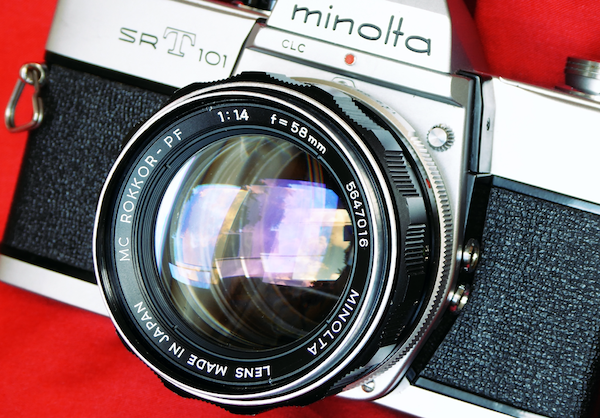
Minolta SR-T 101 Review: – So much has been written about the SRT-101 the world scarcely needs another article on it BUT – it happens to be one of my favourite cameras so I am going to dive in and hope to bring something new to the party. (Q: Seriously Mel you’re going to write about what most be the most written about camera on the Internet? A: Yes I am because it’s so good, deserving of us much time as you can devote to it).
Where to start though – I could blather on about its ground breaking approach (it took Nikon almost 10 years catch up with its auto indexing feature), I could ramble on about its mechanics and how it’s almost bombproof and I could cover how long it stayed around thanks to its solid design and its many virtues – and I will cover a lot of that but lets start at the beginning.
Minolta SR-T 101 Review – A time and a place…
Before looking at the SRT series it’s important to place it in its time. It’s very hard to understand how an artefact from a bygone time is the way it is unless you understand the times it was created in. The Minolta SRT series started with the SRT-101 which was released to the public in 1966. Given the relatively slow pace of camera development at the time it would be safe to assume the camera was in development for at least 5 years (it took 10 to develop the later X1).
So let’s take a beat and consider the state of the world and its technology in the early 1960s. Computing technology was a world away from today – the IBM 1400 Series started shipping and had a whopping memory of around 16k. These were the first truly modern computers as someone today would understand computing. They were slow, the electronics were something fearful and the whole system would be occupy the space of a squash court.
Minolta SR-T 101 Review – The state of computing in the 1960s. Analog Military Computer for Torpedo Targeting and an IBM-1401 Digital Computer.
For fast processing and compact design the world relied on analog computers. These used a series of gears and motors to solve complex trigonometry and differential equation type problems required for real time applications like anti-aircraft weapons, bomb sights, torpedo targeting etc. (you get a glimpse of some of these in the films ‘Run Silent Run Deep’ and ‘When Worlds Collide’)
The micro-chip was not yet in production and processor chips were almost two decades away.
In camera technology the things we take for granted today like automatically returning mirrors and automatic lens stop down had only emerged around 1958 – scarcely 10 years before the SRT series started shipping and then only for the premium end of camera gear. Some cameras were using manual stop down as late as 1974! Through the lens metering (TTL) wasn’t available until 1963 and only then on the extremely expensive Topcon Super. It was followed by the almost as expensive Nikon F in 1965.
If you want to get a feel for the 1960s watch the movies ‘Alfie’ or ‘The Ipcress file’ it will give you the flavour of the times. The relatively low tech world of the 1960s was very different to today. I included this section for younger readers to maybe give them a feel for the times from which emerged one of Minolta’s most wonderful achievements – the SRT Series.
The Road to the SRT Series…
In 1958 Minolta launched the SR-2, One of the first cameras ever to have an automatically returning mirror, automatic stop down AND a bayonet mount (Nikon would go wth a bayonet mount 12 months later – Pentax would take another 10 years!) – this would be the SR mount though its usually incorrectly referred to as an MC mount which would stay common on all Minolta cameras until Minolta launched the first practical Auto Focus camera in 1985, giving the SR mount a life time of 30 years! It was however an expensive camera so Minolta followed up with the quixotically named SR-1 which cut a few things down to get the price right. Over the next few years Minolta progressively released newer versions in the SR series. Some of these were stylistic changes to the cameras looks and some were to introduce improved handling and build quality. The SR series would culminate in 1962 with the SR-7 model – the first camera to incorporate a built in CdS meter cell – although not through the lens.
In 1966 the SR series would be withdrawn to clear the way for the most advanced Minolta camera of the time with a raft of features that would make it Minoltas most successful camera for the next decade.
Minolta SR-T 101 Review – An early version of the SRT-101 dating from 1968 with the black shutter speed control. The SRT-101 would be changed slightly a few years later but its basic mechanics would stay the same for the next 15 years.
Minolta SR-T 101 Review – The SR-T 101
The SRT-101 launched in 1966 and was a huge leap forward over the SR series. Although superficially resembling an SR series camera the SRT is entirely different inside. The SRT-101 featured through the lens metering (TTL) and critically open aperture metering. Other manufacturers could do TTL but often only with the lens stopped down. You had to stop the lens down, take a meter reading, make suitable changes to the f-stop and shutter speed and then open the lens up for focusing and shooting. Minolta swept all that away- Now you could meter, compose and shoot with the lens fully open which made things easier and faster. Now Nikon could do this the year before (for a lot more money) but Minolta added auto-indexing to the whole system. As soon as a lens was fitted the camera would know what f stop you had set on the lens and adjust its meter accordingly. With Nikons system, assuming you could afford it, you had to ‘program’ the meter by turning the lens aperture ring all the way to the lowest f stop to synchronise the meter to the lens and turn the lens to its highest f stop number to remove the lens. None of this with the Minolta approach – you just pressed the lens release button and twisted the lens off. Minoltas system was known as Meter Coupled (MC) and they released a whole series of lenses, mostly adapted from the SR series cameras Auto-Rokkor (AR) lenses.By simply adding a small tab to the aperture ring the basic lens could stay with the same optical design– this gave Minolta a very definite edge. Automatic meter coupling, simpler lens release and a complete set of lenses straight out of the bag on launch date. Over time many of the AR series of lenses were redeveloped with improved optical formulas to become some of the best lenses ever made. The Meter Coupling system used by Minolta would eventually be copied by Nikon 10 years later with their Automatic Indexing System (AIS). That kind of shows how far out in front Minolta were.
It didn’t stop there though with just auto indexing and ease of use – the SRT also supported stop down metering for earlier Auto-Rokkor (AR) lenses and any other lenses that might lack the meter coupling tab. Inside the camera a system known known as the ‘AV Safety’ very neatly made sure that you would not take a stopped down meter reading and apply it to a wide open lens by accident. The meter will switch off entirely if you enter stop down mode with a an MC coupled lens and will likewise switch off if a non-MC lens is being used in open aperture. Through a simple series of switches the camera always presents the true metering situation to avoid user errors. This was deleted on later models as the need to stay 100% compatible with lenses made a decade earlier was less of a demand.
The SRT also added what Minolta called Contrast Light Compensation (CLC). A simple kind of matrix metering. The camera would adjust the metering based on the scene. This really only works in landscape shots but basically there are two meter cells. One reads the top half of the scene and the other reads the lower half. This was designed so that the sky (usually the brightest part of a landscape picture) would be compensated out to provide more even exposure for the whole image.
In addition to all of this good stuff the SRT featured a very large mirror so there would be no image cut off even with very long telephotos lenses a shutter speed display in the viewfinder and they topped it off with a camera that felt ‘right’ with good ergonomics and great handling.
Minolta had, with the SRT-101, made a giant leap forward. There was no motor drive connection but back in 1966 no one was much worried about that. Minolta did though create the SR-M which was basically an SRT with no meter and a permanently fixed motor drive – it was never successful as a seller. The SRT-101 though would become the biggest seller for Minolta in the late 1960s and early 1970s.
So why all of the stuff at the start about analog computers? Well simply this. When the SRT-101 launched microprocessors were 30 years away. The big task was how to get a meter to respond to varying light levels and to correctly calculate the exposure values for f stops and film and shutter speeds. The answer is under the hood. The SRT uses a match needle driven by a simple two input mechanical computer composed of strings and pulleys to ‘solve’ the exposure ‘problem’ this is a borrowed technology from military analog computers of the period. I say it’s simple, in terms of how it works, it is, but I’d have hated to be doing the math to calculate the various pulleys and string lengths which must have been something dreadful to calculate. The whole system is held in tension by a single large spring. It’s simple, ingenious and it works! Nikon did it with the Nikon F metered head by using a huge wheel with a resistor strip. It’s bulky, complicated and almost impossible to repair. Minoltas simple solution has proven to be far more reliable.
Minolta SR-T 101 Review – The SRT metering system. Two pulleys are designed to work against each other – both connected by cords. One to the aperture follower and one to the shutter speed control. The pulleys counter rotate and act on a pointer – when the pointer is matched to the meter needle you have correct exposure. It’s brilliantly simple but the math to calculate the system must have been horrific!
The SRT swept all before it in its day (well apart from the Nikon crowd – who would though eventually succumb to Canon’s EOS almost 2 decades later) and it became the best ever seller for Minolta. The SRT would carry on until it was progressively phased out starting around 1977 but it would be 1983 before the SRT was eclipsed in sales volume by the X-700 which was microprocessor driven and made of plastic. By the time of its retirement the SRT had been in production for 15 years. Few cameras ever had such a long production life.
So tell us about the camera…
Well the SRT spanned a fair chunk of time. From the very first SRT-101 to the last model being sold (the SRT-100X) is a span of 15 years. Across that time period many changes were made to the camera. Later models often featured extra features and some of the very late models started cutting down on features as the SRT was progressively downgraded to an entry level product. For the purposes of this article I’ll only talk about the SRT series in general terms. If you want specific information about each model then ‘The Rokkor Files’ is the best source on individual models.
So on to the SRT. It’s an extremely fine camera to work with and handles ‘right’. As mentioned it has open aperture metering so long as it has an MC or the later MD lens on it and it can of course use non-MC lenses in stop down metering. Its viewfinder is not up there with cameras made over a decade later but it’s perfectly good enough and better than most with a fine matte screen, an unobtrusive meter and a good field of view.
The SRT is of course, apart from its light meter, wholly mechanical and extremely reliable. Almost the entire camera is made of metal apart from one small gear wheel (the mirror kick gear) which is almost never a problem with the camera. It’s quite a heavy lump compared to later cameras bit it’s very solid and tough.
Minolta SR-T 101 Review – An SRT with its top cover removed, almost entirely made of metal – its simple and tough. This one has the earlier un-sculpted advance lever seen on later models.
The focus screens are rather good in them giving a bright and clear view but early ones do not have a split image viewfinder and rely on a micro-prism dot for focusing. Almost all models support shutter speeds from 1 second to 1000th plus ‘B’ with the exception of an early budget model – the SRT-100.
The viewfinder in the original SRT-101 includes a shutter speed display, Minolta later added an aperture display to some models. Some very late models deleted both viewfinder displays.
As production moved on across 15 years numerous small changes were made. The most obvious from the outside is the loss of the FP synch for flash bulbs but later the AV Safety system was removed so the camera would meter constantly whether in stop down or open aperture – by the time these models launched there was less demand for backwards compatibility with older lenses. On the early versions the stop down/depth of field preview button locks into place which makes sense for convenience when metering. On later models with no AV safety the stop down/DoF is simply sprung.
An SRT-101 Viewfinder. You match the circle with the meter needle and you’re good to go.
The later more sculpted advance lever. Many SRTs lose the tip due to rough handling.
The SRT-303b film safe indicator. It moves as you advance film so you know that the film is loaded correctly.
As time marched on Minolta added a split focus finder and features like a film safe indicator on the 303b version which shows that film is transporting and also that the camera is loaded with film.
You could consider the SRT series to be the perfect all mechanical camera. There is not much to go wrong, almost any good repair tech can fix them and the camera can do pretty much everything you would ever want and of course it’s compatible with almost every single manual focus lens Minolta ever made.
Minolta made a dizzying number of model names for these and the same basic model might have three different names depending on its intended market. I’ll focus on a narrow selection of the more common SRT models though because a full listing would be a very long read indeed…
A quick word on the camera mount as this is often a source of confusion. The SR series used a bayonet mount known as the SR mount. The Minolta SRT refined this with the addition of the aperture indexing ring. The much later Minolta XD refined this further with a an additional lever which tells the camera what the lens minimum f stop is and this is referred to as an MD mount but the basic mechanics are all identical. The Minolta mount is often stated generically as an MC/MD mount. In fact they are all SR mounts and are all cross compatible though you dont get the advantage of extra features when using a plain SR mount lens on an MD equipped camera. The physical connection though remains identical in almost all cases. I say ‘almost’ there was a very early version of the SR mount on some SR2s which is not compatible but these are extremely rare.
SRT-101 – The Original (1966-1975)
The earliest SRT-101 has a slightly different trim to later ones. The most obvious difference is the very early ones have a black shutter speed dial. Later ones have a taller and easier to grip silver shutter speed dial. Internally they are near identical with only minor manufacturing changes. The SRT-101 had both Depth of Field (DoF) Preview and Mirror Lock Up (MLU) and supported both X and FP Synch for flash. The flash connection was by PC cord as the SRT-101 had only a cold shoe. Very early SRT-101s had a significant bias to the CLC metering system. This was progressively softened after and around 1969. The downside of the original CLC system bias is when shooting in portrait mode one side of the frame can unduly influence the overall metering. To counter this Minolta reduced the bias factor.
The SRT-101 was most famously used by Eugene Smith to document the Minamata mercury poisoning industrial disaster and when you see the incredible work that he turned out there you come to see that you probably don’t need much more than an SRT-101.
The SRT-101 would be replaced by the SRT-101b which added a hot-shoe and a film memo holder together with a more refined and sculpted film advance lever.
Minolta SR-T 101 Review – A late model SRT-101 in black with its 58mm f1.4 MCII lens. The camera isn’t dressed without the 58mm f1.4 on it!
SRT-303 – First Premium Version (1972-1975)
The SRT-303 is mechanically identical to the SRT-101 in almost all respects but added an aperture read-out to the viewfinder, a hot shoe and a split image viewfinder in most models – some early models of the 303 lack this. The SRT-303 also provide a multiple exposure facility whereby the film spool was locked in place which provided better registration of the film frames. It’s beautifully simple. When you press the rewind release the film take up spool is locked into position meaning the film stays where it was when the last shot was taken. When you rewind the film it doesn’t cause problems thanks to a simple clutch mechanism.
The film advance lever was also changed to be more ergonomic and this was carried over onto other cameras in the SRT line up over time.
The SRT-303 would be replaced by the SRT-303b model.
Minolta SR-T 101 Review – An early version SRT-303. Some later ones omitted the Mirror Lock Up and some early ones omitted the split focus screen. By the time of the SRT-303 the MC-X Series lenses had replaced the earlier MCII versions.
SRT-303b – Second Premium Version (1976-1977)
My personal favourite – the SRT-303b like the other SRTs is mechanically identical in most respects to the SRT-101 and the SRT-303 but removed the Mirror Lock Up. The SRT-303b added a film safe indicator which showed that film was transporting correctly and also acted as a warning that the camera was loaded. In addition the rear door was changed to hold a film memo holder.
As a note the SRT-303b sometimes DID have a mirror lock up fitted – this was probably down to Minolta using existing stock parts when the were changing over to the 303b. When dealing with the 303 and 303b models you really have to be sure what the camera has as there is some variance. Also the 303b is usually stated as appearing around 1976 but I have seen an authentic one that has a factory date of January 1975. Like most manufacturers Minolta may have been using part built 303s to fulfil the 303b orders. It wouldn’t be impossible as the internals of both cameras are near enough identical.
The ‘b’ versions of the 303 and the 101 started using plastic aperture rings around 1976 rather than the metal rings seen on earlier cameras. They are quite durable though and I have never seen a broken one yet. They do have an advantage over the metal versions which is they are more resistant to gumming up with dirt and grease than the earlier all metal rings.
Minolta SR-T 101 Review – The peak of the SRT Series – the SRT-303b this one with the MC-X Series 50mm f1.4 – one of the best 50mms from any manufacturer.
SRT-100X – The Last One (1977-1981)
The final iteration of the SRT series was the budget level SRT-100X. Minolta removed the self timer, Mirror Lock Up, FP Synch, the shutter speed displays and the self timer BUT for all that it’s still a very capable camera and indeed some serious photographers prefer it for its uncluttered display and simplicity. Internally it’s still metal through and through but with a lot less of the internal foams which is a blessing (see later). Very late on, almost at the end of production, Minolta removed the twin meter cells and the CLC logo on the front of the camera disappeared, the twin cells were replaced with a single meter cell with an averaged meter pattern.
Minolta SR-T 101 Review – End of the line, the somewhat stripped down SRT-100X but still a great camera to use. This one with an MDII lens which was standard when these were introduced – the MDII lenses were built for the top end Minolta XD.
Buying an SRT today – what’s the risks?
Well any of the SRTs are probably the last bargain on the classic film counter shelf. More capable and less expensive than the Pentax K1000 and most of its contemporaries and they are generally solid performers but – their reputation for reliability is something of a two-edged sword. The SRT contains a great many internal foams and these are almost always decaying into a poor state inside the camera. Left untreated these will eventually cause problems. I created an article that shows what happens inside an SRT a few months back HERE but it’s worth showing some pics again. The hazard is people will often claim the camera is mint and runs ok, externally it might well look clean, wind on and go click but internally things can look very different. Likewise its performance can be suspect unless tested on a shutter tester although to be fair thats common with almost any old camera.
Minolta SR-T 101 Review – The curse of most SRT models, decaying interior foam – the SRT has many foam pads inside – as these rot they can (and do) gum stuff up as well as acid etch parts.
Minolta SR-T 101 Review – More rotting foam in an SRT – to get this out requires a strip down. You can see it’s breaking up and spreading all over the mirror. Left alone it will do damage eventually.
The other hazard of the SRT are its meter cells. Even back in the day these could be troublesome but to be fair the SRT is no bigger a risk in this respect than almost any other classic camera using CdS cells. Replacements are impossible as the cells required have been out of production for many years. Very late SRT models like the SRT-100X tend to suffer less from this as the cells are potentially 10-15 years younger. As the cells die the meter will be less and less reliable in low light situations. Typically they will start to fail below EV8 which is quite dim but they will get progressively worse.
As mentioned most SRTs will run slow on their shutters unless serviced but that’s no different to almost any classic camera most of which will exhibit less than optimal performance unless serviced. With an SRT the surest sign of the lubrication failing is when the mirror fails to return to its down position at slow shutter speeds.
Most copies are nowhere near as smooth as they should be when purchased from places like eBay. The SRT is more reliant than some cameras on lubrication and few copies will have been properly serviced. This translates as a crunchy and cranky advance feel and a slow shutter. I have seen them as slow as 4 stops adrift due to poor lubrication. Lack of servicing affects almost all old cameras and even electronic cameras can suffer issues related to lubrication of their shutter systems.
On the plus side almost all of the major mechanics in the SRT series were interchangeable. The basic guts of the camera remained the same from the beginning to the end of production and given the long production life it means spares are relatively easy to find and most spares are interchangeable between different models. From a servicing point of view they are easy cameras to deal with and the fact that so many of them are running at all is a testament to the quality of the construction. The SRT series was built to a quality thats unimaginable today. The most common external fault is that the early ones have a relatively weak plastic tip on their advance levers. These can easily be sheared off by improper or overly rough handling.
The SRT was designed to run on mercury cells – these are no longer available. The easiest way to power them today is vis a zinc air hearing aid battery (Type 675) using an adaptor. You can’t simply use a 1.5 volt battery and adjust for error as the meter performance is logarithmic not linear. People do promote a modification using a diode but this also will cause meter readings to be in error thanks to the SRT’s non linear response. Frankly with 675 batteries being cheap as chips it seems pointless to seek more complex and expensive solutions.
Minolta SR-T 101 Review – In a nutshell…
The SRT is a genuine classic from the golden age of film cameras. Ground breaking and a marvel in its day (Minolta sold millions of them) and still an incredibly good camera to use today when in a serviced condition. The SR mount gives the SRT series access to almost every Minolta lens ever made and Minolta were among the top tier of lens makers – some of their glass is the best of its kind.
The Pigeon Man – Shot with a Minolta SRT-303b and 35mm f2.8 MC-X lens using Ilford HP5.
Medieval Bridge – shot with an SRT-101 and 28mm MD Rokkor with yellow filter and using Ilford FP4.
The SRT models are relatively inexpensive to buy and have serviced and are solidly made. A fully serviced one from High 5 Cameras can be had for just under £200 with a beautiful lens – not so much money really for a good as new camera that will easily last another 20-30 years.
It’s an easy to live with, robust and a faithful friend in your photographic endeavours. As mentioned earlier Eugene Smith used an SRT-101 for his work at Minamata and when you have seen his pics you realise just what an SRT-101 can do in the hands of a skilled photographer but it will also perform well from a technical standpoint in the hands of almost anyone. Simple and endearing its a camera which does what it says on the tin and gets the job done with no fuss. If you get an SRT the most impressive lens, and no SRT is truly dressed without one, is the 58mm f1.4 PF. It’s a lens with a character all of its own. A good one will render superbly in black and white. If colour is your thing get the later MC-X 50mmf 1.4 PG for it’s superb sharpness and beautiful warm colors.
I have shot a great range of cameras and have owned many of them including Nikon, Canon, Olympus and Pentax. I have chosen to keep 2x SRTs as my main shooters. That should tell you something. They just work – and I am never so happy as when using one for the simplicity and reliability.
Thank you all so much for visiting our site and for the great feedback. This site is also a labour of love and we are passionate about keeping it alive for as long as possible. If you found this site/page helpful why not buy us a coffee to say thank you and say hi. We love to hear how you get on with our tutorials and articles. Mel xx
Nikon F Review – Perhaps the most iconic camera of all time is the Nikon F. Still a desirable camera for both photographers and collectors after 65 years. Used by pretty much every press packer in its day, photographers in the Vietnam war, and the US space program. Instantly recognisable in any movie and the preferred camera of many photo-journalists.
I used one back in the glory days of film SLRs and still use one today.
So why is it so revered? Is it as good as it’s supposed to be? Is it really indestructible? Lets take a look…
Nikon F Review – The classic Nikon F with Photomic FTn Finder and 50mm f1.4 – the only camera I ever really need.
Rallying the troops…A little history lesson on the Nikon F.
It’s a little known fact that Nikon management were not keen on the SLR concept. Nikon had carved out a nice niche for themselves in the rangefinder market. They were pitched squarely against Leica who they had their sights set on. Photojournalists in the Korean War stopping over in Japan were amazed at how good Nikons lenses were. They started touting Nikon lenses to their friends. As a result Nikon had already started to eat some of Leicas market for glass. So it was natural for Nikon, with Leica in their sights, to focus on rangefinder cameras at the time.
It seems neither Pentax or its management, who pretty much perfected the SLR, were ever keen on the SLR design. They felt 35mm would never have the quality required for serious photography and favoured medium format film. However, in the end they were swayed and the SLR concept gained traction. Nikon management took a view that the SLR was not where serious photographers would spend their cash. Remember they were gunning for Leica and many photojournalists back then were Leica users. They were eventually swayed, so they adapted their SP rangefinder to accept a mirror and a prism. The F was born.
The Nikon F Prototype on show at the Nikon Museum, Tokyo clearly showing its SP rangefinder heritage.
In 1957 the management at Nikon authorised 3 prototypes. These were essentially Nikon SPs with some extra bits bolted on to prove (or disprove) the concept. The initial prototypes had a straight through finder along with their SLR finder as Nikon felt the ‘blackout’ as the mirror went up might put some photojournalists off the whole idea. You can see the finder window on the right side of the camera at the Nikon Museum in Tokyo. It must have worked well enough because in 1959 Nikon unveiled the Nikon F. The rest, as they say, is history…
It has been said that it was Konica who started the ball rolling and started making the coffin the German camera industry would be consigned to but it was most definitely Nikon who banged the last nails in. Probably using a Nikon F to hammer those nails down – it’s a very tough old camera.
Building up…. The Nikon F Design
The original Nikon F was designed to use titanium shutter blades. Such was the pace of demand that the earliest ones used a cloth shutter. These very early ones are highly desired by collectors and can fetch very large sums if original and clean. Sales took off so fast for the Nikon F that the factory initially couldn’t keep up. Nikon quite literally couldn’t make them fast enough. Even senior management could be seen on the factory floor hastily helping to assemble Nikon Fs. Penance for being doubtful about the viability of the SLR concept – that’s karma for you.
Nikon went their own way on design of the F. The camera was designed to be entirely modular with replaceable prisms, focus screens and film backs. They opted for a very harsh looking design with squared off edges. This was quite different to other cameras around which had largely favoured a contoured and curved look. Nikon were quite intentional about this – they wanted the camera to stand out.
Nikon F Review – Early Nikon Page Ads from 1960 and 1962 stress the Nikon Fs lineage and modularity.
The camera is fully metal through and through – even the shutter blades are titanium. Under the skin it’s quite a simple beast and it’s designed from the ground up to be tough and reliable. Needless to say there’s no plastic in the design apart from a few minor trim items on later models.
Make no mistake though for all its simplicity and agricultural mechanics the F was primo gear. A standard body with the basic prism and 50mm f1.4 lens would be costing around £3,000 in todays money. Inflation calculators only tell half the story though. In the money of the day a basic new F was approximately half the price of a new Austin Mini.
On release the Nikon F had a standard prism but it was quickly upgraded. First there was an external meter that clipped on to the top of the camera. Then a metered head which used a separate photocell (Photomic T). Later still through the lens metering (Photomic Tn) with its averaged meter pattern. Finally the ultimate finder the Photomic FTn setting the standard for all future Nikon finders. Utilising the classic 60% centre weighted metering pattern. It also set the standard for what a Nikon F should look like with its weird, other worldly, asymmetrical look. This made the Nikon F instantly recognisable.
For a more detailed look at Nikon F finders follow take a look at Mir.Com
Nikon F Review – Nikon advertising from 1965 stresses the ‘Pro’ angle, the modularity and of course their newest TTL finder. Like most Nikon advertising it was low key and understated.
There were other finders available for the Nikon F including a waist level finder, a sports action finder and a magnifying finder but the Photomic FTn would be the one that almost anyone would recognise and for me it’s quintessential finder for the F.
Nikon would go on and bash out almost a million Nikon Fs over 13 years. Indeed, such was the demand, production carried on for 12 months AFTER the replacement, the F2, appeared as Nikon filled back orders and even new orders from people who demanded the original Nikon F.
Combat…The Nikon F takes on all comers…
The Nikon F quickly became a favourite for photo journalists and press packers. It was used by photographers extensively in Vietnam where its high quality lenses, toughness and reliability was greatly appreciated. Some of the most iconic images from the Vietnam war were shot by photographers like Tim Page, Nick Ut and Don McCullin using Nikon Fs and of course it’s lived on in a clutch of Vietnam War movies like Apocalypse Now and Full metal Jacket.
Tim Page sporting a Leica, Nikon F, a Nikkorex and a machine gun! Who said camera straps were for sissies. – Nikon F Review
Nick Ut with a Nikon F and a lot of mud. Nick Ut would take one of the most iconic images of Vietnam with a Leica.- Nikon F Review
Don McCullin with a Nikon F, probably in Hue where he would take one of the outstanding pictures of the war. – Nikon F Review
The camera itself and Nikons design and manufacture takes some of the credit but what really drove the Nikon F to be top dog in the rarefied air of professionals was the marketing genius of Joe Ehrenreich the US distributor. He saw to it that every major photojournalist was seen using a Nikon F at major events. He also saw to it that NASA selected the F for space missions and that it was seen draped around the necks of everyone and anyone who might need serious photography. The Nikon F would make Nikon synonymous with quality professional gear for a long time to come and cement Nikons position as THE professional choice.
Interestingly Nikons marketing was elegant, professional but very subdued even by the standards of the 1950s and 1960s but then when you’re getting your camera seen with everyone who’s anyone including astronauts and Hollywood celebs then magazine adverts can afford to be not much more than ‘stop me and buy one’.
Nikon F Review – Everyone wanted a Nikon F and Nikon were very adroit in getting it seen with celebs – (l-r) Mick Jagger, Brigitte Bardot, Janis Joplin, Marilyn Monroe, Leonard Nimoy, Paul McCartney.
Retirement – The War is Won
The Nikon F was finally discontinued in 1972 – a year after the Nikon F2 replaced it. Apparently Nikon still had backorders on their system. Such was the demand for the F that even with the later, more refined F2 available people out there still wanted the original and so Nikon carried on turning them out for around 12 months after the replacement F2 was available. Production of the F stopped sometime in 1972 after an estimated 862,200 units had been produced. For a camera that sold less than a million units the F had created a huge impact and was instrumental in propelling Nikon to an almost unassailable position for almost 30 years. It had firmly won the war for Nikon but also crucially won the hearts and minds of its customers which would stand Nikon in good stead going forward. Other companies raced to catch up with the Nikon F – Minolta with their technical marvel the X1 which appeared just as the F phased out in favour of the F2. The X1 was a technological tour-de-force but it never found favour with professionals and was too expensive for almost anyone else. Canon, likewise, launched the F1 in 1971 but Canon would play catch up with Nikon for years and would never make more than a small dent in Nikons professional sales. Both Minolta and Canon tried to out engineer Nikon and missed the fact that Nikons foothold was not based on technical supremacy but marketing and the huge lead they had acquired. Canon eventually just gave up and went in a different direction. And no other camera company could ever get a foothold into Nikons professional market until 1989 with the launch of the Canon EOS-1.
Nikon F Review – Pretender to the throne No.1. The amazing Minolta X1. Minolta would try to out tech the Nikon F2 but it was never successful.
Nikon F Review – Pretender to the throne No.2. The beautifully engineered Canon F1. Superb but too late – Nikons lead from the F was too large.
This is my Nikon F…There are many like it but this one is mine
I will confess to being pretty passionate about the Nikon F. As I grew up it was the camera that many people, including myself aspired to. It had almost mythical status. Sadly, as I already covered it was priced well out of the range of most including the pimply teenager version of myself back then.
I used to look at them in shop windows with my nose pressed against the glass. I eventually owned an Olympus OM-1 which was itself a pro camera but priced less aggressively than Nikon who could wring some more shekels out of people just for the name!
But as luck would have it around 1977 a Nikon F turned up in my local camera store followed by another soon after and the prices were getting a lot lower. This was undoubtedly due to the F2 putting in an appearance and finally getting traction as pros started trading in for F2s and the price of the now semi obsolete F model was reduced to a low enough price for me to afford – I swear when I eventually got one even 2nd hand it felt like I had been held upside down by my ankles by the camera shop and given a shake just to get the last few coins out of me. I don’t know – maybe the camera store owner took pity on a young waif of a girl with a passion for film. In any event I ended up with two of them and some nice lenses and for a very long time they were my primary shooters. I used them extensively for press work and product shoots at one time.
Nikon F Review – This is my Nikon – there are many like it but this one is mine. Surrounded by some of its vintage glass that’s still used regularly.
So how does it handle? It’s one heavy lump of a camera for sure weighing in at 1.2kg with a 50mm f1.4 and the FTn finder. I used to lug two of them with a camera bag but these days due to advancing years if I take an F with me it’s likely just the camera and one lens due to the weight. ‘Scuse my weediness I’m sure.
The viewfinder is a bit dated and nothing like as expansive as an Olympus OM-1 or as bright as a Minolta XD. The film advance has a grindy feel and is quite crunchy lacking the smoothness of a Minolta XD or a Canon FTb. Lens mounting is a bit of a faff with the Nikon shuffle – when you change lenses you need to twist the lens aperture to the smallest f stop (eg f16) for easy removal and then when mounting a new lens rotate the lens all of the way to the widest aperture (eg f1.4) and then back to synchronise the meter. Crikey! That’s sounds a faff! You do get used to it but it’s nowhere near as slick as Minoltas MC (Meter Coupled) system where you just plug the lens on and the camera sorts itself out. Nikon did eventually get it right by copying Minolta about 10 years later and calling their system AiS (Auto Indexing System).
With a removable prism the F has a fitting for a hot shoe over the rewind capstan
Festooned with buttons and knobs – note the early NK stamping. Laters ones are stamped Nikon.
With the prism removed you can change focus screens. This is the ‘E’ type grid screen.
Older Nikon lenses all feature the trademark lobster claws on the top of the lens. It’s these claws which link to the meter. You can use lenses that are missing the claws like the much later E Series lenses but you would need to use stop down metering – many later lenses omitted the claws as Nikon moved to the AiS system.
The F doesn’t have a hinged film door. Instead like an old school rangefinder the entire door slides away from the body. In some ways its less fiddly for loading film but in other ways it’s an absolute arse of a job if your mobile and you really do have to be careful around those titanium shutter curtains. The removable back and base was so Nikon could add alternate backs/bases for motor drives and auto winders.
The ‘Lobster Claws’ exposure meter coupling prongs.
Nikon F – Film door comes away completely allowing different backs to be added.
The Nikon F Titanium Shutter Curtains.
So, given all those apparent down sides why use it? Simple – the quality. It may be less tech, less smooth but it’s super reliable, built like a tank, its huge weight and all metal construction means mirror slap is almost undetectable. So much so you could be forgiven for thinking you were shooting a rangefinder – it’s that solid! And…The camera and lenses always deliver great results.
Is it as tough as they say? I can’t say for sure but I used one of mine to smack a wallaby on the head after Skippy decided to kick a load of small kids to the ground and then started bouncing on them and looked like it fancied its chances against me. One smack on the head from the Nikon F being used like a mace and chain convinced the wallaby that laying down and playing possum might be smarter than to carry on pushing its luck. I have always felt a bit guilty about that – the Nikon could have suffered real damage.
I use mine with vintage Nikon glass from the same period as the camera and while not all of the vintage glass gives as good results compared to later model lenses the massive stand out though is the 50mm f1.4 Nikkor which always delivers. I’d go as far as to say if I could only keep one camera and one lens the Nikon F with its 50mm f1.4 would probably be the one (God forbid I should ever have to choose though).
Nikon F, 50mm f1.4 Nikkor-S – Mod Scooter with Expired Fuji 400 scanned to B&W
Nikon F, 50mm f1.4 Nikkor-S with Fuji 100 Technical Film – River Thames and converted Mill House
Nikon F, 50mm f1.4 Nikkor-S and Ilford FP4 – Painshill Park
For you the war is over….Buying a Nikon F today…
If this article has made you want to get out there, get a Nikon F and pretend you’re Dennis Hopper in ‘Apocalypse Now’ or maybe David Hemmings in ‘Blow Up’ then get ready to spend some cash. The Nikon F is tough but like any old camera they were designed to be serviced regularly. Runners are not hard to find that will reliably advance and fire but you may find the shutters are running slow on many of them. Finding an FTn finder with a working meter is also a challenge.
The most basic un-metered prism is paradoxically the most expensive prism of the lot these days. With that said even if a Tn or FTn metered head has a non running meter it’s still perfectly useable as a finder.
The F doesn’t suffer too many major issues as its such a basic camera in its design but like any of the top end classics spares are hard to come by and likely to be expensive. Even people selling complete wrecks usually want £100+.
My current Nikon F (because like an idiot I sold the original pair for pennies as digital took over) was purchased in Tokyo with a working FTn meter head, the much sought after ‘E’ type focus screen with grid lines and a 50mm f1.4 at a cost around £280. The camera was a solid runner but testing back in the UK showed its shutter speeds were off and meter calibration was out. I had mine serviced to get the meter calibrated for use with 1.5v batteries and have the camera given a thorough service. Servicing costs topped £150 for the camera and an additional £50 for the lens so the whole package came in at £480. You can see its not a cheap classic to own but after servicing my own Nikon F shoots perfectly.
I mentioned the meter recalibration. The Nikon FTn head was designed with 1.35v mercury batteries in mind. You can use 1.5v and compensate in your shooting or you can use Zinc-Air batteries and an adaptor (for more information read my article on powering old cameras here). There is some information out there that says that due to the design of the FTn head the camera will compensate for 1.5v batteries – I found that NOT to be the case. I don’t like the faff of compensating for higher battery voltage as it can lead to mistakes and constantly changing zinc-airs in the meter head is also a faff. The battery chamber in the FTn finder is underneath the meter head requiring the meter head to be removed. It’s not hard but it is a nuisance so I had the meter recalibrated for 1.5 Silver cells which was the best compromise.
The most common issues with old Nikon Fs is a degraded prism caused by foam break down inside the prism, dead meter cells and damaged focus screens. It’s very hard to find a perfect focus screen. Other issues are people poking the very fragile titanium shutter blades. Reject any camera with shutter blade damage as repair costs will be very high. The prism itself on all versions contains foam which will degrade and slowly eat the prism silvering – unless the foam is changed out its a question of when, not if, the prism gets destroyed.
If you’re going to buy a Nikon F then servicing is a must. Ignore people who will tell you that an F is so indestructible it never needs servicing – chances are it will shoot but poor lubrication and a lack of attention to the finders internal foam seals may soon render the camera inoperable or junk. Spares are expensive and hard to come by so treat the camera with the respect it deserves and get it serviced.
Nikon F Review – My own Nikon F with an elderly Nikkor-Q 135mm lens. Like the camera the lenses from this period often need servicing.
This is the end…
The Nikon F set Nikon up for huge success in the professional market place. As mentioned no other company could get a serious foothold in the professional market for years after the lead that the Nikon F had established – its rivals like the Canon F1 and the Minolta X1 would take 10 years to develop and appear right at the very end of the Nikon Fs production run – Nikon had had a 10 year lead which turned out to be almost impossible to overturn.
Canon, Minolta and Olympus would all make sales in Nikons ‘Pro’ market space but these were no more than a fleabite on the hide of the Nikon elephant. Nikon went on refining their professional products and it would not be until 1989, 30 years later and the launch of the EOS-1 that Canon would finally start to wrest away the professional market from Nikon.
The F is instantly recognisable in many classic and cult films and these have only served to increase its allure for many modern film photographers. (L-R) Kevyn Major Howard as ‘Rafterman’ in Full Metal Jacket, Dennis Hopper as the photojournalist in Apocalypse Now, Sigourney Weaver as Diane Fossey in Gorillas in the Mist and Linda Hunt (in an amazing performance) as Billy Kwan from The Year of Living Dangerously.
The Nikon F being used by David Hemmings in the cult movie ‘Blow Up’.
Paradoxically the very success of the F would be Nikons undoing. Nikons downfall would, in part, be the struggle to keep compatibility with the Nikon F lens mount in a fast changing market made even tougher with the development of auto-focus. The desire to keep the F mount had its parallel with Pentax years earlier who persisted with the M42 mount – by the time Pentax woke up and delivered the ‘K’ mount they had been overtaken. Pentax would never recover – and neither would Nikon.
To their credit Nikon tried hard at keeping stuff compatible but it came at the price of not being easily able to adopt new technology – like many companies being at the top for so long proved in some ways a disadvantage. Arrogance creeps in and never losing can itself be a weakness.
Nikon compatibility guides today look like a hologrammatic score for an opera overlaid with Stephen Hawking’s calculations for Black Hole radiation. Canon bit the bullet and just dumped their history and went with an entire new generation of cameras – the EoS and this would enable them to develop new technology faster. Eventually Canons superior Auto-Focus technology made possible by the EoS mount would be the undoing of Nikon aided and abetted by Nikon clinging on to the F mount for far too long.
The Nikon F though lives on as one of the truly iconic classic cameras. It retains a mystique which many later cameras just lack and still retains its near mythic status and an association with glamour which gives it a unique position amongst classic Japanese film cameras from the golden age.
Thank you all so much for visiting our site and for the great feedback. This site is also a labour of love and we are passionate about keeping it alive for as long as possible. If you found this site/page helpful why not buy us a coffee to say thank you and say hi. We love to hear how you get on with our tutorials and articles. Mel xx
Pentax Film Camera Project :- Over the past 12 months there has been a flurry of speculation that Pentax would soon bring to market a new 35mm film camera.
Much of this has been provoked by some interviews with people at Pentax who are working on their film project. There are tons of speculative reports on this and doubtless with 5 minutes of searching online you will find the same interviews being rehashed in various forms.
Here’s our take on what we can expect coming soon, what we can expect coming later and why of all the manufacturers currently around Pentax would choose to launch film – it does make a kind of sense after all.
Before we get stuck into speculation lets take a quick look at the Pentax history.
In 1957 Pentax pretty much created the 35mm film camera that we all came to know and love. Their basic design stood the test for nearly 40 years and the same basic layout was used, with a few notable exceptions, by every major 35mm SLR film camera manufacturer.
In 1964 the Pentax Spotmatic launched, which built on the basic layout of the original Pentax camera and lasted until 1975 when Pentax launched the ‘K’ series. The flagship KX has been all but forgotten among modern film users but it was pioneering stuff in its day. Silicon photo diodes for it light meter and the then radical departure (for Pentax) from the classic M42 screw mount to the new ‘K’ mount from which the series derived its name. The budget camera from the series was of course the K1000 – built to a lower specification than the KX for students and the financially constrained.
From the original Pentax to the K series the cameras were built like a tank, solid, heavy and reliable but after the arrival of the Olympus OM-1 all manufacturers looked to shrink down their offerings to dinky sizes. The Pentax solution was the MX. One of the very last all mechanical, manual focus SLRs.
The budget K1000 trudged on until 1997 making it a contender for the last manual focus 35 SLR though the Minolta X-300 can also lay claim to that title and probably does pip the K1000.
So you can see Pentax were there at the start and there right at the end of the all mechanical 35mm film cameras. It’s written into their DNA.
So why start making film again? Of the big 5 manufacturers in the heyday of Japanese cameras Pentax have been the only player to not be terribly successful in the world of digital cameras. Their digital offering, while amazingly sophisticated has just lacked the heavyweight punch of Canon and Nikon. Minolta of course ceased making cameras altogether in 2006.
With a rise of interest in film and weakening sales in their digital line it makes sense for Pentax to be the first mover in getting back to film to try and capture a potential emerging market. There are rumours that Nikon are also looking to get a film camera back into production. There’s also some sense here, as Nikon are probably still smarting from losing out to Canon way back. Nikon did indeed make a limited edition redux of one of their early rangefinders. Prices were astronomical and production was severely limited to the availability of parts they had left over in inventory. We don’t doubt Nikon are also eyeing the film market.
So why is it taking so long? Well, putting even a simple compact point and shoot together needs a fair amount of work. Lenses have to be designed and here’s the biggest problem. No one has had to design a film transport mechanism for 30+ years. Older designers and experts have retired and the word from Pentax is that they had a lot of problems. Modern designers had not realised just how complicated it is. The Pentax Film Camera Project team admitted they had to get people out of retirement to get the mechanisms debugged and working. Anyone who has had the guts of a camera to pieces will appreciate theres a fair amount of springs and gears needed to make it all work. Unlike the golden age when there was a base of existing products to build on and designers and engineers were still around this time it’s all having to be done from scratch.
Pentax Film Camera Project: It ain’t as easy as you may think. This the base of an SLR but a compact needs similar gearing.
To the simple, all things are simple. After all it’s only winding film from one end of the camera to the other isn’t it? Well the short answer is no. As the take up spool in the camera increases in size as more film gets wound on the camera has to have gears that allow for that so the frame sizes stay the same. The sprocket winding the film through the mechanism has to stay in synch with the take up spool which is getting bigger with each picture you take. In addition the gears have to wind on the frame counter and arm the shutter. It all makes for a big challenge in mechanical engineering.
Whats the plan? From all the hype it would seem that Pentax are most likely to develop a simple compact in the first go. From reading all the announcements and pronouncements we are thinking something very basic. Probably manual winding, fixed focus and probably not too far from the current Kodak offering though perhaps with better optics. Pentax have since suggested there will be four cameras in the initial line up so we think that will come out to be probably a very base level point and shoot either fixed focus or basic auto focus and built in flash. Probably a more de-luxe version with autowinding and here’s the real gem – Pentax announced recently that one of the four will be a basic camera with a replaceable lens. So we could be looking at something akin to a K1000.
From the point and shoot side of things we’d imagine Pentax will aim low on spec but high on quality. It’s typical for the far east to start with something simple that they know they can get right and reliable. The Japanese makers are never shy of running a ‘back margin’ – eg selling below cost to kickstart the market and then release version 2 with more features at a higher price to get any losses back. It’s the way the far east operates. Get the reliability and price right and then find out how to make money from it later.
Kodak F9 – possibly where Pentax will go on launch.
The dream camera for many would be something akin to the Olympus mju:1 / Stylus
We expect something akin to the current Kodak line up at the start and probably something more akin to the vaunted Olympus mju:1 (also known as the Stylus) later on. The Olmpus mju:1 has a huge following and even clapped out examples will fetch £90 and up so its potential fertile ground to kickstart a new market.
While rebuilding a K1000 in its original form might be hard work it does kind of make sense. The late Chinese copies of the K1000 were primarily plastic. We could imagine it having a K mount lens fitting – it would make sense as there is still so many K mount lenses out there and frankly it would be hard to imagine Pentax would do it different – the K mount, like film, is in the Pentax DNA. They own the design and it would cut down the time needed to develop any lenses as they could simply repackage known designs. The design could be simplified and reduced rather like the Minolta X-300. It wouldn’t be hard to build program mode into it. When program mode first became available in the 1980s it was a tough one to do thanks to the electronics but today with custom chips you could build a manual focus camera with full program mode quite cheaply if the will were there to do it.
An early Pentax K1000 and a late model Minolta X-300. The Minolta is probably the last manual focus 35mm SLR in production – the Chinese versions only ceased production in 2012!
The Chinese were making clones of the Minolta X-300 right up to 2012 (probably pipping the K1000 as the last manual focus film SLR in production) and managed to strip the design down to just its basic essence and get the price low. The X-300 was a stripped down version of Minoltas premium X-700. Minolta cut down costs by using plastic, replacing complex and expensive mechanics with electronics and simplifying the top deck to speed construction and chip the price down. Theres no reason Pentax couldn’t do the same today. What will the new Pentax camera cost? Currently anyones guess. Our bet would be the compact would run around £100 to £200 and the SLR if it were to mature to a live product will probably run around £1,500 – maybe as high as £3,000. Much depends on what the Pentax game plan is and they haven’t’ really said much. If their game is make some cash then they will aim at premium but they will have problems there because who is going to spend £1,500+ on a new film camera when they could buy a rock solid classic like an original K1000 for around £200 or less. So a lot will depend on the feature set that Pentax have in mind and what their marketing plan is for these cameras.
As a guide to pricing in 1985 a Minolta X-300 cost around £125 – allowing for inflation that would mean it would cost around £400 today. BUT…. the premium cameras back then were closer to £400 which, allowing for inflation would mean a price of around £1,200 today. I’d very much suspect that the Pentax 35mm film SLR, assuming it comes to market will carry a premium tag price of at least a 40% uplift so that would equate to a tag price of around £1,700. For Americans reading this just change the £ sign to $. It will be the same because Pentax will pitch to the $ price and when that stuff comes across the pond this kind of product will just do a 1:1 exchange.
When will we see the Pentax Film Camera Project deliver? The Pentax Film Camera Project suggest 2024 will see the launch of the first four cameras so the next 12 months will be interesting for all of us film fans and users.
Dont be surprised if Pentax stay close mouthed or even misdirect and spoof. They will be as aware as anyone that the other manufacturers are watching closely.
One of the best kept secrets of the golden age of Japanese cameras was Minolta never telling anyone they had cracked auto-focus, in fact they never even said they were even looking at it. They let Pentax and Nikon bumble about showing prototypes that never really worked at trade fairs and then wallop! Delivered a killer punch to the market. It didn’t play out in the long run for Minolta. For us lovers of film lets hope Pentax have better luck.
Update 13th Jan 2024
A recent briefing by Pentax regarding future developments did not yield much information. Pentax are staying very close mouthed about the film project. As we said in the original article they are unlikely to show any cards just yet. The industry as a whole is sceptical about this but with Pentax clearly struggling to stay relevant in digital it would make more sense than ever to get back to film.
A recent video the Pentax Film project released extolling the virtues of film showed, in a short clip, what could be something like a 35mm SLR in development.
The dream of many – a redux of the classic K1000
Responses from various film forums also show a large amount of scepticism but the common themes are very similar. Here’s our response to the most frequent sceptical comments.
1 Film is a Shrinking Market
Is it? This is heard from many forums these days but we would question that. Kodak most recently sold off a lot of its subsidiary and secondary businesses to invest in film production. Over 350 new staff have been taken on to support film production and Kodak are finding they simply can’t keep pace with demand. That doesn’t sound much like a shrinking market to us. Smaller than in its heyday? Of course it smaller than the glory days of the 1970’s and 1980’s but analyst expectation is for a steady growth in film. You can quibble the numbers but the fact is film is growing. Harman, the owners of Ilford, have just invested in Phoenix – a brand new color film with a new emulsion. Numerous Chinese manufacturers are also ramping up. These are hard headed business decisions being taken. Yes they are undoubtedly a risk but our experience is that businesses seldom take big risks so they are in fact betting on a near certainty or at the very least a high probability of making money
2 Surely film uptake is just a blip
Again the question would be is it? People said the same about LP sales 20 years ago (what younger folk call vinyl) yet vinyl sales have increased steadily for the last 16 YEARS! Most modern artists release on to vinyl these days. 16 years worth of year on year record numbers can’t be considered a blip! With substantial increasing sales new manufacturers have come into the market to produce the hardware like record decks too. People find the sound is nicer, its more immersive and therefore more enjoyable to listen to. That kind of sounds like the same reasons people move into film cameras and away from digital.
3 There’s so many old cameras out there who will buy a new one?
The same people who currently buy record desks for vinyl – there are hundreds, probably millions of old record decks out there but after 40 years in an attic stuff breaks down. Just like old cameras.
Classic cameras from the 1970s were designed with servicing in mind. Few of them will ever have had it. Shutter speeds will be off by a mile on most of them plus internal seals will have failed in many cases. Some of this stuff is doable by the average person like the light seals but a Minolta SRT for example has 22 foam and rubber seals inside, these will have perished. Even the mighty Nikon F will start to lose accuracy, suffer prism rot and dried out lubrication. Who’s going to repair them for you? Most techs are now ageing and close to retirement. Last year alone saw three of the UKs few remaining techs pack it in for good. Even if you can find a tech spares are hard to come by and in some cases impossible. Whole model ranges and marques are now impossible to repair and that will only get worse as time goes by.
So, there are plenty of cameras out there for now – but who will be around to fix them for you?
Lenses are another weak spot for film cameras. Many lenses from the 1970s suffer dried out lubrication, as the lubrication vaporises it deposits oil vapour onto the glass surfaces causing haze. Many lenses from the 1980s used encapsulated elements making repair or cleaning impossible. Earlier lenses survive better but even they can fall foul of terminal conditions like coating failure caused by fungus.
Just like vinyl – if film is to stay here people need to be making new stuff that’s reliable – the camera industry in its hey day turned out a few million cameras but it’s not infinite and as time goes by some of these, maybe most, will start to fail. Certainly if film is to have a future there will need to be new products – Kodak and Harman aren’t going to stay making film if its just a few old farts shooting their classic Exacta or 1964 Spotmatic.
4. Surely the price of film makes it impossible to imagine it gaining ground again?
People keep raising the price of film as an argument. If you do an inflation calculation you will find the cost of most films is now not so different than it was in the 1970s.
An old magazine advertisment I found gives a price for a 36 exposure roll of HP5 at £1.80 in 1984. Using the Bank of Englands inflation calculator gives a price today of £5.71. Shopping around you can find Ilford HP5 at around £6 so yes its gone up slightly but it’s hardly that much more expensive and you can always opt for plenty of budget films out there for a lot less. Check out Mike Eckmans page here
Even allowing for the cost of some of the more exotic films they are still less than a cup of hot brown water and a mass produced muffin in one of the trendy (and pretty ghastly) coffee franchises.
I always find it odd that people will whine about the cost of film but are seemingly happy to part with a more substantial sums from some hot brown water or some nasty chemically produced beer which currently sells at £5.90 a pint in the UK. In part the price is undoubtedly down to shortage of supply but it would be fair to say the cost of raw materials has increased over that time.
The rising cost of film is in fact all the more reason why we all need a modern camera, or at least get old ones serviced while you still can. If the costs of taking a picture on film is in fact rising you really don’t want shots wasted thanks to an unreliable camera that suddenly exhibits shutter capping or a lens which is hazing badly.
5 It will be hugely expensive to design a new film camera
Well it would be expensive but not unreasonably so. Modern manufacturing techniques and CAD/CAM will cut the cost. Back in the 1960s many of these camera designs had to be done by hand, people actually drawing the parts up using a pen and paper. Skilled staff were needed to make the parts and more skilled staff were needed to assemble the parts into the camera. Development of a new model could take two years (the Minolta XE was almost 10 years in development!) because prototypes had to be made as one-off models. Today a lot of the work can be done on a computer, prototypes can be 3D printed or CNC machined very rapidly. Pentax have by their own admission struggled because some of the know how has been lost but once they are over the hump they will speed up exponentially. Lens design like the mechanics can be done very quickly these days with CAD systems. Compared to the cost of silicon chip design and manufacture a mechanical camera and lenses wont be THAT expensive to design and of course should Pentax go the K mount route that will cut lens design time down considerably.
A good comparison here is telescope manufacture. Back in the 1960s companies like Unitron (then in their heyday) charged a huge amount for their wares. Manufacturing telescope lenses and tubes created virtually a hand made product. Today companies like Synta in China can turn out a vastly better spec telescope in lens sizes that amateurs back in the 1960s could only dream about for not much cash. Parabolic mirrors which back in the 1960s were the preserve of serious observatories and NASA are now readily available at specifications that would be have been beyond scientific grade back then. And remember the amateur astronomy market is quite tiny. We’d find it hard to believe there is a sufficient market size that allows modern lens companies like Synta and Televue to produce an ever more amazing array of gear for a tiny number of people who do serious amateur astronomy and yet a similar sized market of film enthusiasts wont find a company willing to do likewise. Synta and Televue are having to push the very boundaries of whats possible with optics – a redux of a film camera from the golden age requires a lot less investment than developing a whole new generation of gear that pushes the limits of optical design every 12 months or so.
6 Is any of this real?
Well you better believe it. Industry reports are very divided but the overall outlook is film is growing at around 2.8% (it may be as high as 8% depending one which report you read and how you interpret the data) and the smart phone market is in decline as the market is now at saturation point. Many people are turning to something a bit more thoughtful than a phone to store their memories.
One of the headaches for analysts is that unlike days of yore when there were a few big players to keep an eye on and you could easily analyse their earnings reports these days there is a very fractured market space with a very high degree of segmentation. Yes you can easily find out what Harman or Kodak are up to from their sales numbers but you are blind to what’s happening at Orwo or Kosmo films or the two dozen other specialists producers of film products and of course no industry analysts are going to be looking at the sales volumes of second hand cameras from J.Bloggs Photo Mart so a lot of the analyst reports are guesswork. Our bet is the potential market is very much underestimated – lets hope so for a new film camera from Pentax.
Update 18th March 2024
Pentax announced on the 1st March that the new film camera will be a vertical format, half frame camera with zone focusing so we’d expect it to look more Konica Pop than anything. Pentax now predict Summer 2024 for release. The usual notices from Pentax about how terribly tough its been to get the technology back from the dustbin it was all consigned to years ago but some things have become more clear in their announcement if you read between the lines.
First off is the rationale for the film camera appears to be retro style for a younger audience so expect a low quality offering for retro style photos. The vertical format and half frame may play well though. The vertical format will make it seem more like a smart phone which may help make it look familiar and therefore more be appealing to younger buyers (If you have never seen a vertical format half frame so a web search for the Taron Chic). The half-frame format also saves on film costs as you’ll get 72 shots from a roll instead of 36 albeit at the expense of quality but the lower price will save on film costs so it makes sense for a younger market.
What was most interesting about the update from Pentax was their statement that they wanted some assurance that film would be available and they are now comfortable that film will be around so are now green-lighting this for production. Us film fans should take a measure of comfort from that because you can bet your prize camera that Pentax wouldn’t do a thing unless they had some solid assurance from the likes Kodak and Fuji that they weren’t planning on getting out of film anytime soon.
On forums it’s overall been a big thumbs down as people keep wittering on about who will buy a film camera given the fact that most people smart phones but here’s a thought for you. Back in the hey-day of film most people NEVER owned any sort of camera or at most a snap-o-matic point and shoot like a Kodak Instamatic. Classic shooters today largely seem to forget that the prosumer and professional SLRs of yesteryear were always a very tiny market. You may think of classic cameras as being made in the millions but few ever were – many classic cameras were made in quite small numbers. There were a few exceptions but these were almost always cameras aimed at the low end of the market proving the point. Almost all camera production was geared to point and shoots. The point being that the people today blatting pics onto their smartphones were the people who back in the 1970s were never going to own any camera at all! The fact that most people didn’t own a camera or have any interest in owning one did not change the dynamics of the market back then and the idea that people who own a smartphone wont buy a camera wont change the market dynamics for a modern film camera today either – those are the people who simply were never going to buy a camera anyway either then or now.
As we have said before the best chances of keeping film alive are new products coming to market so we are wishing Pentax every success in this one. Anything which gets people interested in film has to ba a good thing.
Thank you all so much for visiting our site and for the great feedback. This site is also a labour of love and we are passionate about keeping it alive for as long as possible. If you found this site/page helpful why not buy us a coffee to say thank you and say hi. We love to hear how you get on with our tutorials and articles. Mel xx
Nikon F-301 Review:- One of the most underrated 35mm film SLRs in todays world has to be the Nikon F-301. I suppose that is to be expected considering it had a very short production life and was generally hated in its day by the Nikonista fraternity.
Launched in 1985 and withdrawn around 1987 the Nikon F-301 was almost the last manual focus camera from Nikon for the consumer end of the market (the FM 10 was made by Cosina) and followed on from the rather nasty EM and FG models but my-oh-my – third time was a charm. The Nikon F-301 despite its Nikonista detractors is a marvellous camera to shoot with.
Let’s take a look at how it arrived, why it was dead before its time and just how good it really is.
When is a Nikon F not a Nikon F? – When its a Nikon F-301 of course! – Hated by Nikon fans but every bit as good as anything Nikon ever made.
Nikon F-301 Review : Third Times a Charm…
After the major success Canon had with the AE-1 launched in 1976 all of the manufacturers wanted a taste of that large market that Canon had successfully opened up and every major manufacturer got to work to scoop up some of those consumers with spare cash in their hands and a fancy to own a 35mm SLR. Minolta would be the only player to seriously eat into Canon’s dinner but it’s fair to say everybody wanted a slice of that pie including the mighty Nikon – home of the serious camera for professionals.
Nikon, not wanting to be left out of this new gold rush, got stuck in, rolled up their sleeves and launched the EM in 1979, an unashamed entry level camera, the EM supported only aperture priority auto. Nikon even made the camera tiny so it would better suit female sized hands (aww bless them). The EM was barely in production for three years before being withdrawn. Reliability was a big issue with the EM. Its electronics had a reputation for unreliability and doubtless Nikon feared for their brand image, and also probably got tired of whiney-ass consumers cluttering up the repairs department. On the plus side the low cost Series E glass designed for the EM really cut the mustard – being within an ace of the top end Nikkors.
The EM wasn’t a complete disaster – from the EM came the amazingly good E Series lenses.
Undeterred by a minor set back like an unreliable camera that no one wanted (not even the girly types it seemed) Nikon rolled up their shirtsleeves (again!) and got on with producing a replacement. This would be the Nikon FG released in 1982.
The FG would be the first Nikon ever with program mode and the first Nikon with TTL flash (though trailing behind Minolta who got there first as usual a year earlier with the X-700). The FG also supported full manual and aperture priority and with its vertical metal bladed shutter it should have been a winner but, sadly, those pesky electronics let it down again and like the EM, Nikon found themselves knee deep in repairs and dealing with even more legions of shouty customers on the phone.
Oh dear! The consumer end of the market was going to be a lot harder than I expect anyone at Nikon imagined.
Doubtless one of the problems Nikon faced was that before the EM they had never really dabbled in the bottom end of the market except for point and shoots. It’s all very well being ace at producing top end gear where money is no object either in production cost or the final ticket price but getting the right blend of features and reliability at the bottom end of the market actually takes some doing as a fair few manufacturers had said on their way to a bankruptcy hearing.
It’s easy to forget that back then while Nikon, Minolta, Canon et al were busy cramming silicon chips into tiny cameras the computer I am typing this on and the one you are doubtless reading it on was in its infancy. PCs back then were B-I-G, like the size of a suitcase big, expensive and almost no one owned one.
The bottom line here was getting chips into a camera to run off tiny voltages and be fast and reliable was not so easy as it would seem to younger folk today who take reliability for granted. Back then TVs, Stereos and the like failing was a fact of life.
Nikon, and you have to admire their persistence here, were unfazed. A lesser manufacturer may have given up (and indeed some did, and some went bankrupt too!), but the FG was duly retired in 1985/86 when they unveiled consumer camera number three.
I would like to believe they called it the F-301 because it was in fact the third time around to try and get it right. It would make a good story except they ruined it by calling it the N2000 for the US market!
So would the F-301 be a case of third times a charm? Read on…
Nikon F-301 Review : Shock and Awe
Its fair to say the Nikon-F301 made quite a splash when it arrived. Its styling was somewhat radical copying the overall look of the professional class F3 in its general appearance including the new Nikon brand styling red stripe.
The F-301 was the first Nikon to have a polycarbonate body and the first Nikon to delete the film advance lever in favour of a built in motor drive – you could hear the Nikonistas getting triggered by the noise that grinding teeth make when en-masse – almost as loud as the racket the F-301 makes when its motor drive kicks in. It was also the first Nikon to use DX coding.
Some considered it a new dawn for Nikon but traditional Nikon users hated it with the sort of passion normally seen in medieval religious warfare.
They hated the plastic, they hated the complete reliance on electronics (there’s no mechanical mode here sonny), they hated it because it wasn’t made out of armour plate and didn’t have lots of tiny gears whizzing around. They had only just accepted the professional grade F3 having an electronic shutter and now this…a completely plastic camera! First it was the threat of nuclear war, then the rise of international terrorism, we might all be murdered in our beds and now this – a Nikon made out of plastic! It was all too much! Surely the end of days was fast approaching!
That was the shock – what about the awe. Well the F-301 was the consumer camera to end them all, verging on prosumer territory and even in use by pros (more on that later).
By the time the F-301 arrived Canon had the AE-1P with program Mode and Shutter Priority (SP) and Minolta had the X-700 with Program Mode and Aperture Priority (AP). The F-301 would support Aperture Priority (AP) and TWO Program modes. One for normal use optimised for aperture and one for fast action optimised for shutter speed. On top of that Nikon would use a metal vertical bladed shutter to give the camera stunning accuracy and speeds up to 2000th where the Canon AE-1P and Minolta X-700 used cloth horizontal shutters which limited them to a maximum speed of 1000th.
Nikon really pulled all the stops out with the F-301 and gave it TTL flash like its predecessor the FG, a very fast internal autowinder/motor drive that can run faster than some dedicated motor drives and on top of that gave it one of the brightest and sharpest viewfinders of any SLR. Only Minoltas X-700 with its Acumatte screen can beat it and it would be a photo finish as to which is the brightest and best. The focus screen is by any reasonable definition superb and some go as far as to say maybe the best focus screen Nikon ever made.
To help the beginner Nikon gave the camera an automatic film loading function which made loading film as simple as most of the point and shoots, PLUS DX coding so the camera would set the film speed for you if you wished though you could set it manually and the camera would helpfully alert you if no DX coding was set. It also used AAA batteries which gave it a huge battery life even if you were using the motordrive. For an absolutely flat out superb prosumer camera Nikon cut the price and managed to get it into the consumers mitts around 10% cheaper than the front running rivals from Canon and Minolta.
Oh yeah – they also got it to be reliable. Third time really was a charm for Nikon.
Nikon F-301 Review: Film speed ring and exposure compensation, DX coding can be set and the camera will beep and flash the LED if the film doesn’t have a DX code.
Nikon F-301 Review: Very traditional controls but no film advance lever which made the Nikonistas gnash their teeth.
Nikon F-301 Review : Poor Boys F3
It has been said of the F-301 that it’s a poor boys F3 but that doesn’t really do the F-301 justice making it sound like a cheapo knock off. Inexpensive it may have been but it’s a fabulous shooter of a camera in its own right.
Its program mode is just about the best I have ever used and left to its own devices it can almost always get the shot even when lighting is tricky.
Nikon had produced the Series ‘E’ lenses for the ill fated EM series and most F-301s were sold with the Series ‘E’ lenses as a low cost alternative to the Nikkor lenses mostly associated with Nikon. These budget lenses now have a cult following and frankly they are within a hair as good as the Nikkors. I seriously doubt anyone would ever notice the difference . You can read about the Series E lenses in the preamble to the repair guide here.
I came to the F-301 via owning Nikon Fs as a Pro. For my holiday camera or just lightweight use I had traditionally used either a Pentax Spotmatic or an Olympus OM-1. The Nikon F is wonderful but its also heavy and bulky so for holiday use and day trips with the family I would take a lightweight swinger with me. In a moment of madness and uncharacteristic brand loyalty I bought an Olympus OM-4Ti from a shop while out and about as my new swinger and found I hated it.
I hated its overall poor performance, hated its fussy meter and mostly hated it because it ate batteries like Smints and spent more time at Olympus being repaired than it spent doing any actual shooting. I was at the end of my tether with the OM-4Ti after a years-worth of it always playing up and while in my favourite camera shop venting about it while chewing the edge of their countertop they helpfully offered a Nikon F-301 on approval. As a consummate Nikon F user I was somewhat surprised by the F-301, it looked so unlike any Nikon I had ever seen but I was hardly a brand loyalist (The OM-4Ti had cured fangirl-itis for good) so I thought ‘well why not?’ it could accept most of my Nikon lenses which was a bonus. A big plus for me at the time was I did a lot of travel to out of the way places – while you could always find someone who could sell you some AAAs finding someone who could sell you some weird mercury battery was always a challenge. I spent a whole day in Kefalonia in ’82 seeking SR44s to keep the OM4Ti running as it munched its way through the entire carton of spares!
Nikon F-301 Review: One of the biggest attractions for me was the camera using standard cells. No more hunting for weird batteries when out in the back of beyond.
I found in use the F-301 performed amazingly well. With its very fast built in motor drive it could rival almost any other motor drives for speed and get it all in a relatively compact package – smaller and lighter than almost any other SLR with a motor drive attached.
The only missing feature was a depth of field preview which most budget and consumer cameras leave off and which, back then doing press work, I never used anyway.
I loved its big bright focus screen, its near perfect program mode which could always pull a shot and its toughness. It may be made of plastic but it’s a tough camera.
I liked it so much I not only went back and paid for it but had another one as a back-up. Over time the F-301 started to be used more and more for professional work and there hangs a tale.
One of the F-301s was damaged badly on a freelance shoot and so I went back to get another and damn! It was no longer available.
I can’t state the veracity of this but the guys in my favourite store told me that Nikon had stopped making it because it was starting to eat sales of their top end gear. Press packers like me who always needed spares had usually of course bought a spare F3 body or an FM. Some of these had opted to start using F-301s as backups and why not! It was cheaper to risk an F-301 in a riot than an F3 after all. Now I can’t say whether that’s true or not but it has a ring of truth to it. I suspect the real reason though was the rise of Auto Focus cameras. After all the Nikon F-501 came out in 1986 and was basically an F-301 with Auto Focus. With Auto Focus taking over the the market F-301 was retired in 1987 – barely two years since it had launched.
I managed to find a spare from shelf stock elsewhere and continued using them and enjoying them until the millennium when I started cutting over to digital.
A word here on professionals using amateur gear. It’s always worth remembering that owning professional cameras doesn’t make anyone a pro. The feature sets may be richer but the real magic in photography is the eye of the photographer. Most of the 20th centuries most iconic photos were taken with cameras with a lot less sophistication than the Nikon F-301. Check out Steve McCurry’s Afghan Girl taken with a prosumer Nikon FM2.
Here’s some pics on a trip to Bruges – all but one were done with a Nikon F-301 and a 50mm f1.8 E Series lens on Program mode. As you can see the camera calls it pretty close to perfect.
Tricky lighting? The F-301 makes short work of that with its program mode. Perfect exposure every time. Bruges Christmas Market on Fuji 400.
Program mode with the F-301 is superb. Back alley in Bruges with Kosmo Films Agent Shadow 400 at ASA 800.
Program mode with the F-301 is superb. Nightscape in Bruges with Kosmo Films Agent Shadow 400 at ASA 800.
Very long exposure with a Tamron 24mm and Fuji 400. F-301 on Program mode for a long exposure.
Nikon F-301 Review : Loud and Proud
The F-301s worst aspect by far is the racket the motor drive makes. It’s ok when you’re covering a riot or being all elbows in a press pack but for a lot of subjects the clamour of the auto winder is a bit distracting. Ok you can imitate the start of ‘Girls on Film’ or even pretend you’re a super spy getting shots of a Bond villain but it can be quite off-putting for some stuff.
On the up side the camera uses 4x AAA batteries and these last longer than most people will be shooting film for. Typically they can last for a great many rolls of film – as many as 30 rolls before you need a battery change. If that’s not enough for you Nikon did a bigger battery base as an option which would take 4x AAs. Unfortunately those giant AAA and AA batteries mean the tripod mount can’t be in the centre of the camera and Nikon used a very offset tripod fitting. You could buy a special adaptor to add to the base of the camera but obviously its increased bulk and weight. It’s just as well the batteries last a long time because without them the camera is a brick – theres no manual backup at all.
The F-301s greatest virtue though was the amazingly good viewfinder and the amazing Program mode which can almost always pull off the shot even when the light is tricky. Program mode on the F-301 works best with AIS lenses. It will also run with AI lenses in Program mode which is unique to the F-301 and and the Nikon FA. Non-AI lenses are a complete no-no. Non-AI lenses lack the slot for the cameras aperture follower and will either jam the follower or worse break it.
Nikon F-301 Review: AI and AIS lenses only for the Nikon F-301. Non AI lenses can jam or break the relatively fragile aperture follower circled in the picture.
Nikon F-301 Review: Exposure lock and self timer – like everything else with the F-301 the self timer is electronic
The viewfinder contains LEDs along its right side which show the shutter speed you have selected and the shutter speed the camera suggests or, which it will shoot at, if in AP or Program mode. The LEDs will also warn if you have selected Program mode but have not turned the lens down to minimum aperture.
The focus screen has a split image focus finder plus a microprism collar and a circle which shows the meter weighting zone – like most Nikons the meter is 60/40 centre weighted and the circle shows the 60% zone. When paired up with its fast 2000th of a second shutter speed and traditional controls for full manual operation the camera is a wonderful blend of high tech mated to traditional controls. Electronic it may be but there’s not an LCD panel in sight which gives the camera very traditional feel even though the whole thing is being run by a microprocessor.
Nikon F-301 Review : Third Times a Charm (Part 2)
The biggest headache with buying a Nikon F-301 today is the fact that although back in 1987 they could be trusted, like many electronic cameras the F-301 can suffer terminal failures due to its ageing electronics. I had to buy three duds to get a good one and another three duds behind that to get a second one that was also good.
The biggest risk to them is the damn batteries – you see the batteries lasted so long that people put the camera away and forgot about the batteries. They had probably never changed batteries since buying the camera new. Of course large alkaline batteries have a nasty habit of leaking and filling the camera with toxic acid and fumes. The surest way to know the provenance of an F-301 is check the base which is also the battery cover – if it shows evidence of corrosion then reject it unless the seller has evidence showing the camera is a complete runner.
Nikon F-301 Review: The biggest hazard to the buyer – Broken F-301s – these have damaged shutters, broken aperture followers and blown electronics.
Nikon F-301 Review: The F-301 has no memo holder instead it uses a see through area – the seal here can be a problem and lazy users and techs often just cover this up. The seal is quite complex to cut.
Nikon really did get it right back in the day and assuming you can find a good one it should be reliable enough. One of its upsides is that it was consumer grade and many mums and dads will not have used the camera much when they bought it. Meaning any good ones will probably still shoot a fair few thousand frames before they ever need attention so long as grandad took the batteries out!
The shutter in the F-301 is VERY accurate – among the most accurate I have ever tested. Of the good ones I have acquired the shutter can usually hit almost the exact speed with very little variance on speed every time. Typically a cloth horizontal shutter will have a deviation of around 20% and will deviate somewhat from shot to shot. The vertical shutter in the F-301 is almost always exactly right and has amazing consistency.
The final consideration you should give to any Nikon though is the cost of lenses. Nikon lenses command a big price tag even for the budget ‘E’ series which have now reached the level of Nikkors for pricing on the second-hand market. So, if this article makes you want to own a Nikon F-301 then consider the lens costs before you jump in. Even third party lenses get pricier as soon as they have a Nikon mount.
Nikon F-301 Review : Forgotten by Most
If the F-301 had been in place a bit earlier I suspect it would have been a world beater but in business timing is everything. Some products arrive too early and scare the consumers away, some arrive too late and the market has moved and some appear just in time but face reliability or production issues. For the Nikon F-301 it was just the perfect product but two years too late. With the Auto-Focus revolution in full swing by the time it arrived its core market of prosumers was melting away.
The Nikon F-301 today has been generally forgotten. It was in production for such a short time and it commands little respect from Nikon fans who were and are more swayed by Nikon F2s, FMs and FEs which are more pro or prosumer cameras with a better pedigree and look more Nikon than the F-301 ever did.
The F-301 may have been a case of third times a charm from the perspective of Nikon getting it right at the budget end of the market but like almost every late model manual focus 35mm SLR the F-301 would be a casualty of the autofocus revolution.
Forgotten by most – not by me who still enjoys the F-301 mightily – you might too.
Nikon F-301 – Pros & Cons
Pros
2000th second shutter speed
Super accurate shutter
Superb Program Mode
Standard Batteries
Fast built in Motor Drive
Cons
Odd tripod socket
Styling
Lens costs
100% Reliant on Power
Thank you all so much for visiting our site and for the great feedback. This site is also a labour of love and we are passionate about keeping it alive for as long as possible. If you found this site/page helpful why not buy us a coffee to say thank you and say hi. We love to hear how you get on with our tutorials and articles. Mel xx
This Canon AE-1 review was originally titled ‘Why I Hate the Canon AE-1’ – But I decided against it. There are so many reasons I actually do hate the AE-1 it would be hard to know where to start or finish and it might have ended up like one of those horror TV shows that goes on for hours as people list the 500 greatest things of a thing ever, interspersed with paid for reminisces by people who never had anything to do with any of it, but gurn on about how it was ‘inspirational’ and ‘changed their lives’.
There are reasons I hate the Canon AE-1, its bland, soulless, made of plastic, has horrible ergonomics and it would be easy to simply slag it off, but I felt I should be more magisterial, above pettiness and personal prejudice and balanced.
I also considered as a title ‘C-C-C-Canon and the Terminal Cough’ but thought it would be too obscure. Of course the Canon devotees would have been quick to point out how unfair that was given the cameras age and the problems of old cameras in general and, in truth, it would have seemed cruel – rather like laughing at someone with dementia who is now mowing the lawn with a vacuum cleaner. Understandable but no less cruel.
All things considered and wanting to be fair I elected for ‘Look Out! Theres a Monster Coming’ after listening to a Bonzo Dog Album. The Bonzos help me maintain a sense of the surreal and bizarre which is sometimes needed when working on a camera.
So why the title then? Well the Canon AE-1 was most definitely a monster. A monster seller for sure being the first 35mm SLR to sell more than a million units backed by a monster marketing campaign which was got the AE-1 sold faster than anyone at Canon ever dared dream. But it was a monster in other ways too. It heralded the end of really high quality cameras and a shift to plastic. I have written in previous articles about the last of the quality cameras like the Pentax MX and the Minolta XD7. Now it’s time for a monster sized read looking at the scary monster that helped bring about their demise.
Going back…
Back in the 1970s the name of the game for the camera industry was to get more 35mm SLRs sold. It should be remembered that for the aficionado of film the 35mm SLR was where it was at, but in fact SLRs only accounted for a tiny portion of the camera market. The bulk of the market was point and shoots.
The problem with the point and shoot market for the manufacturers was they were cheap and that it was hard to sell accessories. Not even a flashgun as most of the point and shoots had an integrated flash so not much money to be made.
The advantage of the SLR for the manufacturers was once you got the customer to buy an SLR you could then sell them a flashgun, a bevy of lenses, maybe a motor drive. This all translates to money in the bank. Of course the manufacturers phrased it differently. ‘Give us your money’ isn’t ever going to be a sound marketing catchphrase outside of an armed robbery so the pitch to the punter would be they could be more creative, shoot like a pro, get amazing pictures and all for the cost of a few weeks wages.
The big headache though was getting people away from their snap-o-matic type Kodaks and this had two problems. Number one was getting the camera to do some of the work to make life simpler and number two was getting the price low enough to make it attractive. Remember in the 1970s with no mobile phones to take a picture for you if you wanted a snap shot of a graduation, a wedding or a family holiday it was film or nothing. However most people lacked any real interest in learning photography, they just wanted some pictures of family events. The point and shoot cameras of the 1970s did everything for you. All you had to do was a press a button and wind on. So the challenge to getting more 35mm SLRs sold was get the price right and keep it simple.
Canon had, until the AE-1, been something of a back number. The professionals all went for Nikon who had skilfully marketed themselves as the professionals choice or, after 1974, Olympus – the brash upstart now wowing pros with their dinky sized OM-1 and huge pile of lenses and accessories. Olympus had been able to wow some of the pros with their lightweight fully pro set-up by moving the goalposts to smaller size and lower weight.
Pentax of course had been the favourite of the well heeled but not terribly serious snapper since the start of the 35mm SLR revolution. That left Canon and Minolta fighting like two drunks locked out of the bar at closing time. By the mid 1970s both Canon and Minolta had very tired looking offerings that looked very dated. Minolta had the SRT which harked back to the 1960s and Canon had the FTb which, while newer, looked almost as old.
Both the SRT and the FTb are fine cameras but in the market space of the mid 1970s they looked like dinosaurs. Solidly constructed, reliable but heavy and bulky and, critically, requiring someone with at least some basic nous to get good pictures with them – serious semi-pros and the enthusiastic only and definitely not the average mum and dad market! Those semi-pros and serious amateurs were not a big enough market for anyone and certainly not if you wanted to be king of the heap.
Worse, with the recessions of the early 1970s people had been squeezed financially and the camera market had taken a hit. After all there are only so many people who want to buy an expensive luxury like a camera and the market for 35mm SLRs was showing shrinkage. What was needed was a bump in tech and/or price to get things moving again.
Minolta would go off on a mind bender and develop technical marvels like the XD7 but Canon wanted a bigger piece of pie and they clearly had a plan to get it. Years of making fine cameras had not bought them success – this time they would do it different.
Enter the AE-1 – Monster Sales
Canon probably realised eventually they couldn’t hope to compete with either Nikons prestige, the elan of Olympus or the pre-existing base of Pentax. Canons pro-offerings while amazing just couldn’t make headway against Nikons near monopoly position and the Pentax owners were likely to hold on to their darling Spotmatics until they faded to black.
So, Canon set out with boldness to create a new audience by bagging off the point and shoot users and the fence sitters by enticing them into dark side of 35mm SLR ownership. Muah ha ha!
Canon AE-1 Review: The Canon AE-1 35mm SLR with its standard 50mm f1.8 FD lens
Canon AE-1 Review: Canon AE-1 with its rare 1976 Montreal Olympics Lens Cap
Launched in 1976 and promoted heavily through the Montreal Olympics the AE-1 would be the product to make all this happen. A 35mm SLR which would be mostly made of plastic and electronics to keep the price down and lure the novice with promises of amazing pictures plus they would look like a pro with an AE-1 draped round their neck. The plastic body would save time milling out blocks of metal and the electronics would speed assembly. A typical mechanical 35mm SLR has around 1,000 pieces of precision parts inside. An electronic one cuts that in half or more. Less parts, fewer sub contractors, fewer assembly steps and automation of the production line becomes possible. All of this feeds into lower price for the end user. That’s goal number 1 nailed down. Now what about making it easy?
The AE-1 would introduce automation in the camera itself by providing automatic selection of the aperture. All the user had to do was select a shutter speed and focus and the camera would do the rest by automatically selecting an appropriate aperture. Now automatic modes on cameras were nothing new but they were expensive… the AE-1 changed all of that and coupled with the lowest possible price and a huge marketing push it was enough to turn the AE-1 into a monster. Want to shoot like a pro but cant be bothered to learn anything ? It’s ok the Canon AE-1 will do all the hard work for you was the essence of Canons pitch.
With a Canon AE-1 in your hands you too could shoot amazing pictures without ever bothering to learn anything.
Monster sized marketing
Canon, allegedly, spent as much on marketing the camera as they had in designing and making it. The camera officially launched at the 1976 Montreal Olympics and Canon had a bevy of sporting personalities all lined up to extol the virtues of the automation and sing in chorus about how easy it was to use. An endless stream of sporting personalities from tennis, golf, figure skating and rally driving lined up to start telling people on mainstream TV and media just how easy it was to use. All the hype pushed the AE-1 to record sales numbers in a very short space of time. They even roped in a few professional shooters to give it a ringing endorsement and a professional seal of approval.
Now a seasoned shooter might well wonder at the expertise of a golfer, a tennis player or a figure skater to make pronouncements about a camera but it most definitely worked as a marketing pitch.
I was always dubious about the sample pics from camera manufacturers and doubly so from the Canon AE-1 adverts. They showed a sophistication which I doubt was captured by an AE-1 and if they were being taken with an AE-1 it was being handled by an amazingly skilled photographer.
Canon AE-1 Review : A bevy of sporting personalities lined up to say how amazing the Canon AE-1 was and sing its praises.
The marketing and sales pitch is even evident in the instruction manuals. Canon pitched the AE-1 very hard indeed and each AE-1 came with the traditional very comprehensive manual that all camera suppliers provided back then but the AE-1 also came with a ‘Jack and Jill’ type instruction leaflet for the rank beginner.
Laudable really and this could be used by retail outlets to demonstrate how simple it all was and help steer people into the world of 35mm SLR cameras enabling Canon to potentially sell them a whole array of accessories not to mention the boost in sales volumes from the camera itself.
The whole thing was beautifully packaged for a novice with simple ‘how to’ instructions to guide the beginner in the unknown regions and dark art of 35mm photography with an SLR.
Canon AE-1 Review : Read the Manual – there’s a novel idea many could learn from today!
Canon AE-1 Review : Canon really had it down. Simple instructions for beginners and and no sexism either! Radical stuff for 1976
Monster cut backs on quality
The AE-1 pretty much undercut everyone on the market. The price was very appealing and, of course, on launch it looked quite glitzy. A 35mm SLR camera with automatic mode normally the preserve of the top end of the market at a price that wouldn’t break the bank for too many people. But as ever it came at a price.
Prior to the AE-1, Japanese cameras had majored on amazing quality, all metal and precision engineering. The Canon AE-1 would put an end to that and Canon geared the AE-1 for low price – good enough would be the new watchword. To be fair plenty of them are still running and over time it’s probably fared no worse than many similar cameras from its period. I’ll get into problems with this particular bit of 1970s kit a bit later.
Canon AE-1 Review: Plastic advance lever and top cover showing the wear down to the plastic base.
Canon AE-1 Review: Plastic battery door – the cause of much woe for Canon AE-1 users
Underneath the feel of metal the AE-1 was plastic through and through. Canon disguised this by developing a brass plating that would bond to the plastic top cover. It feels like metal to the touch because of this and, for a black one, a natural brassing look as the paint wears. When it wears down a bit further you will find white plastic. The base plate of the camera actually is metal but its very, very thin.
The guts of an AE-1 are almost entirely plastic, internal levers and gears that were traditionally made of metal are all replaced with plastic parts as far as possible. Gone are the metal roller bearings and fittings and even the film advance lever is plastic.
Canon also adopted a very modular internal construction to cut down on assembly work. Many cameras of the period are assembled like fine timepieces. The Canon AE-1 is assembled more like a consumer piece of electronics. This all sped production and kept the costs down and profits up.
Looking at the Monster
The AE-1 is fairly traditional in its overall looks, its a tad bland but looks about the same as most mid market cameras of its period.
To make use of the shutter priority exposure the FD lenses designed to work with it and its predecessor the FTb all have a small press stud you press down to set the lens at its minimum aperture which is the ‘A’ position. Some of the older FD series use an ‘o’ instead to indicate this as they were geared for the FTb which lacks auto mode.
The top deck is quite clean looking with the film speed and shutter speed dial located under the film advance lever. On looks alone it’s quite a pleasing camera to look at but it does hide some problems. Being mostly made of plastic the film advance has known issues where the plastic studs underneath can shear off and cause the advance mechanism to jam. Theres no way of knowing what Canons quality position was. Typically Nikon and Olympus built their cameras for pro use and to withstand around 50,000 – 100,000 shutter actuations. Canon may well have cut this back a fair bit correctly assessing the average point and shoot user would only use at most two rolls of film a year. If the camera survived five years it would probably be good enough from Canons viewpoint.
Canon AE-1 Review: Canon AE-1 Top Deck – you can see the lens is set to its ‘A’ position for Auto Exposure
The Canon logo is in the old style script which gives the camera a vintage/traditional look and probably explains at least some of its appeal to younger users who are often very much into the retro look. The AE-1 does look the part at first glance especially in its optional black finish.
The camera is powered by a 4LR44 battery which is basically four conventional LR44 types bonded together and this is located on the front behind a fairly flimsy battery door. The catch to open this is a bit tricky and Canon supplied a hot shoe cover that had a small tab on it that could release the battery door. I have been looking for one of these forever but suspect most have been lost or users have snapped the tab off by now. Being mostly plastic the battery door is another weak spot on the AE-1 and broken doors are quite common.
The AE-1, like its predecessor the FT series, used a unique lens fitting called a breech lock. Instead of pressing a release button on the camera and rotating the lens like a conventional bayonet mount the FL and FD series lenses have a rotating ring around their base. You rotate the ring on the lens to release the lens from the camera. It’s locked in position by tension only.
The idea behind this is that lens changes don’t constantly grind against the camera mount ring and potentially cause problems with focus over time but, It’s far less convenient and tricky to manage a lens change in a hurry. Lens swaps are also aggravated by the difficulty in getting a rear lens cap back on which has to be aligned with the lens and then the lens breech lock has to be screwed down to lock the cap in place. It doesn’t sound so bad until you try to manage it standing up at an event.
Later FD lenses reverted to a more traditional bayonet fitting while retaining compatibility with the FD fitting. Sadly these New FD (nFD) types are almost all plastic and many nFD types are impossible to repair due to Canon using a lot of glue and pressed plastic rivets in their construction.
The AE-1 viewfinder gives around 93% coverage which is quite average (an OM-1 sets the high bar on this and gives about 97%). The viewfinder is nice and bright and has a fine ground matte screen with a split image centre and a micro focusing ring. Metering and battery check functions are performed by a single needle in the viewfinder with a mask that shows the cameras choice of apertures.
The nicest thing with the AE-1 by far is its electronic shutter release which is amazingly soft to trigger while retaining a good feel. It also happens to sound lovely when it shoots – it has a very distinctive sound. Some people hate it and I have seen it described a sounding like a screen door being closed onto a wet fish. Allegedly the shutter sound was sampled and used on the iPhone for the iPhones camera – there you are. People often can’t get good pics with the level of an iPhone’s automation and they couldn’t with the AE-1’s back in the day.
Theres no exposure compensation as such on the AE-1 but a small silver stud on the side of the lens mount will give a 1.5 stop over exposures to compensate for backlit situations. Just below the silver stud is a button that will activate the meter and give you a meter reading which seems a bit pointless as half pressing the shutter will do the same.
The AE-1 was never geared to use a motor drive but Canon did bring out an auto-winder for it. A motor drive did eventually arrive with the updated AE-1 Program which is compatible with the AE-1. Personally I’d be nervous of using a motor drive on a vintage camera that uses plastic gears. Motor drives are brutal on a cameras winding mechanism and doubly so when the gears are plastic. The Auto-Winder adds a lot of bulk and when loaded with batteries makes the AE-1 a heavy old brick to carry around. Like the AE-1 itself plastic abounds and the battery door for the autowinder is notoriously fragile.
Canon AE-1 Review: Canon AE-1 with its dedicated Auto-Winder – It turns it into a complete brick to carry around
When using the camera the idea is you set the shutter speed you need, set the lens to ‘A’ and the camera will now manage the aperture for you. It seems an awkward way of running things and positively weird given the AE-1’s intended audience of rank beginners. Most people would favour depth of field. Seeing everything in focus rather than having precise control of shutter speeds which only affect things in motion.
I can’t bring myself to believe that little Timmy in the paddling pool or fluffy the poodle would be moving quick enough to require speed to be the primary hold up on getting a picture. It’s hard to understand why Canon chose shutter priority, especially as its a lot harder to do than aperture priority. Possibly the AE-1 was a kind of test bed for other products or maybe Canon felt the rank beginner would understand the effect of speed more easily than aperture and depth of field.
Shutter priority on a camera with a maximum shutter speed of 1/1000th makes very little sense. Here’s why…
At shutter speeds above 125th some action is stopped (certainly little Timmy in his paddling pool and fluffy the poodle). At 250th pretty much everything is stopped and by 500th anything but the fastest moving objects will appear as stationary. 1000th will stop stuff like fast moving cars but for some very fast moving objects (tennis balls and golf balls for instance) you may need to go faster. Sports photographers tend to favour very fast shutter speeds. So, for someone with a bent for photographing fast moving sports the AE-1 would fall a bit short on the shutter speed options. Frankly no professional sports photographer was likely to buy the AE-1 anyway.
So what about the rest of us?
Well lets assume you are loaded with ASA200 film and you have perfect sunlight conditions and a 50mm lens, your exposure options will be limited to the following: –
At 1000th you will be shooting at an aperture of f5.6
At 500th you will be using f8
At 250th you will be at f11/f16
At 125th you will be at +f22 and out of the range of some lenses.
You can see that your choices of speed and aperture are pretty much restricted to three possible options. Even the lowest speed you can use will stop the average level of action that the AE-1 audience was likely to shoot. And this is under ideal bright sunlight. On less ideal conditions you will be operating with potentially only two possible exposure solutions – corrected for backlight you may be down to a single solution.
You can also see that a very shallow depth of field is out of the question under these conditions. Now given that the only advantage of shutter priority is fast action events like airshows, racing cars, ice hockey and the like you can see that you will pretty much be restricted to a single shutter speed of 1000th. Which really makes any idea of shutter priority pointless. The camera simply runs out of headroom for exposure options.
I always found it strange that given the AE-1 has a very limited capability of shooting fast action sports that Canon chose sporting celebrities to promote it. Apart from golf most sports folk were involved in stuff where you really do need fast speeds and expensive lenses. Way out of the price range of the intended user. But that’s marketing – it’s never much to do with sense and everything to do with emotion.
Why didn’t Canon go the whole hog and have full Program mode? Simple – the electronics of the day were not up to it, at least not at a price that the potential users of the AE-1 would pay. Canon did eventually get program mode on the very much more expensive A1 a year after the AE-1 was released but the A1 was very much a premium amateur/semi-pro camera. In 1981 the AE-1 would be replaced by the AE-1 program which had a full program mode at a similar price and of course Minolta would launch the X-700 to go head to head with the AE-1 Program. While Minoltas X-700 would be a huge success for Minolta it never overtook the AE-1 which set a record of 6 million units sold in 5 years.
Resurrecting a Monster – Buying an AE-1 Today
By far one of the most common issues with the AE-1 today is the famous Canon cough. This shows itself when the mirror stutters on mirror up and/or is slow to react. The cause is dried lubricants deep inside the cameras guts. There are numerous web videos showing how to squirt oil inside to resolve this – it’s a stupid thing to do. The camera really needs a complete CLA (clean, lubricate and adjust). Squirting oil in a camera blindly will almost always result in a quick fix now and an expensive repair bill later.
People who specialise in Canon repairs have legendary horror stories of how much damage and how much extra work is required after well-meaning attempts by users to solve the ‘cough’. The AE-1 never suffered this in its heyday obviously as the lubricants were fresh. A well used one will have kept its lubricants moving about but many AE-1s were seldom used by their owners when new leading to the problems today. This is a common issue with many old cameras. BNIB (Brand New in Box) usually just means the camera will need servicing because lubricants will have dried out so don’t spend over the odds on a BNIB one – its no guarantee it’s a runner and will likely require a service.
As with any old camera you need to make sure it’s a 100% but its an even bigger risk with the AE-1 due to its heavy plastic use and the fact it’s using aged electronics. Jobs which would be simple on a mechanical camera are way beyond the skill set of most people with an AE-1.
The other issue afflicting the AE-1 is the battery door. Replacing this can be a bit of a nightmare as you need to get the top cover off the camera off. Like a Minolta SRT you have to preset the shutter speed to ‘B’ and the film speed to ASA 3200 otherwise the complex teflon cord inside which manages the metering will unwind and it will be no fun resetting it correctly. That leads on to problem number three which is the teflon cord failing. It’s rare but it does happen and if thats happened to your camera you really need a pro to sort it out.
As already mentioned the large amount of plastic can cause issues. A common fault is part of the shutter speed/ASA dial underneath the rings can shear off. There are two small plastic tabs that can be broken. Once gone the film advance will jam up. With no spares easily available its another job for a pro.
Finally the electronics, while generally reliable, are now ageing. You are dealing with a camera thats 40 years old. The electronics are 1970s era and prone to failure like any electronics heavy camera of its period.
The other issues are common to most camera of the same age as the AE-1 which include things like shutter capping due to dried out lubrication on its shutter bearings and rollers. It’s always best to budget in a service when buying a used camera thats this old.
Shooting the Monster
So – whats it like to work with? I bought an AE-1 around 1979. I was deeply sceptical of an all electronic camera but I felt scepticism should rest on solid ground and experience rather than prejudice. Back then I owned a pair of OM-1s but I bagged a shot for a local paper which got me some unexpected cash and decided to buy myself an AE-1 and see what the fuss was about. So I bought myself a black AE-1 with auto winder and a few lenses and started shooting.
Canon AE-1 Review: The weird stop down lever, above it a preview button and above that the backlight control which gives a plus 1.5 stop.
Canon AE-1 Review: The Viewfinder – fairly conventional with the meter to the right showing the cameras selection of aperture
I have to say almost from the off I just hated it. It just lacked any sort of quality feel. All that plastic translated into a cheap and nasty feel far removed from either my OM-1s or even a pair of humble Fujicas I owned at the time. Used as I was to gear from Pentax and Olympus it felt cheap and nasty. Even my old Zenith B was made of metal and felt nicer! The film advance felt brittle, the stop down lever arrangement was horrible and the overall ergonomics made it feel like someone in the finance department at Canon had been allowed far too much say in its layout.
The only thing I liked was the very smooth shutter release which had none of the mechanical bind that even the best mechanical camera has. Its very smooth to trip the shutter with just the right amount of tactile feedback.
Over the course of around a year using the AE-1 it got used less and less. I found it awkward in manual mode where the viewfinder meter display does not give you a read out as such but only advises on the F stop the camera will select in response to the shutter speed you have selected. Normally I would prefer to work the other way round – select speed and then rotate the lens aperture ring to centre a needle. I found the AE-1 to be rather awkward in this respect.
For a serious photographer I found the AE-1s automatic mode to be more of an embuggerment than a help. All this would seem obvious now but back then it was a lot less obvious how the AE-1 would handle – for me at least, badly. On the upside the Canon lenses did render very well and I was quite pleased with them at least.
After about a year I sold my AE-1 on and just forgot about it. With my bump on tech I was sure the AE-1 would be a dead duck and a footnote in camera history and was now certain electronic cameras would be a fad. Time to go back to using the OM-1s.
The shoot of Amanda (see below) was probably the only good pictures I ever got from the AE-1 back then and I came to hate the AE-1 with a passion I usually reserve for dealing with Ryan Air.
When I came back to film a few years back I wondered if I had been too harsh on the AE-1 back in the day and as I had resolved to relive some salad days and past glories by collecting cameras from my past across the last 40+ years I decided to give the AE-1 another chance.
Was it ever as bad as I remembered when I had all the surety of youth? So, I acquired a minty one for another go. The best I could say about it now is it’s not so bad as I had remembered but its very far from ever being a favourite. I still dislike its metering system when shooting in manual and still find it clunky and unpleasant to use. It’s pretty much relegated to being a shelf queen as a result. I just find it soulless and, for me at least, it makes taking pictures feel a chore instead of a joy.
Here’s two pictures taken 40 years apart with two identical Canon AE-1s , same camera, same lens.
Canon AE-1 Review : Amanda – Shot around ’79 with an AE-1 and FD 50mm f1.8
Canon AE-1 Review : Old American Car – shot with Canon AE-1, 5FD 0mm f1.8 and HP5 pushed to 800 ASA.
The Monster Returns
So why is it so popular? Why are prices sky high? And why do people want to own one now?
I think one word answers this – hype! But there are other reasons too.
People who had little or no exposure to cameras of the Canon AE-1 period have latched onto it. It was produced in vast numbers and the marketing hype of its day has propelled it to semi-mythical status. Look – lots of sports people used it. Mum and Dad had one and new age kid with trendy hair on You Tube has one too!
They were produced in the millions so I suspect it’s as Mark Twain once said of Chicagoans in hell – ‘The trouble with you Chicago people is that you think you are the best people down here, whereas you are merely the most numerous.’
When the whole redux of film started I suspect the AE-1 got a grandstand position. With so many produced it had to be good right?
Well not really because large sales numbers seldom speak of high quality, big sales volumes usually speak of marketing spend and getting the price down. The Fiat Punto is not a better car than a Ferrari because Fiat make more of them!
I think there is also a factor that for some it was probably the first ‘serious’ camera they owned and rather like people paying crazy money for Pentax K1000s out of fond memories for their youth they are into the nostalgia aspect. Those are the people who probably had little experience outside of the AE-1 and possibly still think of it as a professional camera. Some of these folk probably have fond memories of mum and dad owning one or maybe have even found mum and dads one hiding in the attic. Being left in the attic is the fate of many prosumer cameras and the AE-1 being so popular means there are probably millions of them hiding in the weeds.
People often bought an AE-1 for some event, maybe a few holidays but despite Canons best effort to make it simple it was still too much for many. Let’s face it some people can’t get a good shot even with an iPhone and so after a brief foray into creativity and the initial glow of feeling a pro many of them ended up as another regretful purchase and were consigned to the never never land of the attic. Too expensive to chuck in the bin but no use for the here and now. Left in attics and storage chests to re-awaken after 40 years.
For some it will be the camera they couldn’t afford when a kid and now want to own one and of course there will be people who started their serious photography with an AE-1 who now want to go back. I didn’t and I don’t – at least not with an AE-1.
Us oldies are often overcome with a feeling of nostalgia and sometimes things we used to own have a kind of totemic effect in making us feel younger.
Canon AE-1 Review: So beloved by modern film shooters but its hard to know why – a perfect mystery
Canon AE-1 Review: The Canon FTb Early Version- No auto mode but no plastic either!
Beyond those reasons I really have no idea why it’s so popular, it’s nowhere near as nice to work with as many cameras of the same period. It’s immediate predecessor the FTb is a beautifully made camera albeit without any automation but these days, even with increasing prices, there are many cameras that are nicer to use than the AE-1 with the same feature sets and many of these truly were professional grade cameras with better handling.
The surprising thing is seeing people recommend it as a beginner camera. Its a very poor tool for a beginner in my opinion unless they are going to just use full auto the whole time. They would be better served by either a fully manual camera like the underrated Pentax KX to learn the craft or else something like the Minolta X-700 which handles a lot better in manual mode. Given the expense of an AE-1 in todays market there are better and less expensive options out there.
Monster on Sales Rampage Eats Everything
The AE-1 was historic in many ways, the first SLR to sell a million units, first SLR with shutter priority, first SLR to feature large scale electronics, first one made of plastic and of course it was the camera that turned round Canons fortunes and set them on course to eventually dominate the industry.
The biggest effect though was at a stroke it obsoleted a lot of other cameras and forced the entire industry to follow suite. As I have said in other articles, after the AE-1 almost the entire market moved away from super high quality, technical excellence to a kind of ‘good enough’ mindset. There would still be many fine cameras for the professional but even these would eventually bow down to the God of economics and market share.
Pretty much the entire industry was altered forever and many fine cameras, and even manufacturers, met their demise after the AE-1.
You could make a case for the AE-1 being pretty much the end of the line for Pentax and Olympus neither of whom would create a truly successful antidote for the AE-1. Minolta of course would punch back with the X-700 which played in the same market space as the later AE-1 Program and would actually come close to unseating it from its position as the biggest ever seller. Other manufacturers tried to grab some of this market with their own plastic bodied cameras but none would ever come close to the volumes that the AE-1 and the Minolta X-x00 series would go on to sell.
If the Olympus OM-1 had been a Zeppelin raid on the industry then the AE-1 was carpet bombing it. It would be left to Minolta though to drop the atom bomb when they perfected auto-focus for the masses at a low enough price to kickstart the AF revolution. With that said Minoltas auto-focus marvel owed much to the AE-1 – it too would be a plastic fantastic made from plastic mouldings and silicon chips with an LCD screen thrown in to boot and press button operation – no more mechanical controls, not even a wind on lever!
For Canon, after years of chasing Nikon for the pro market they had finally found the formula for success. Make it cheap enough, market it hard enough, get the sales volumes and be damned to technical excellence.
Canon AE-1 Review : The bottom line..
It’s fair to say the AE-1 was, and still is, one of my least favourite cameras but like Frankensteins monster the AE-1 is somewhat misunderstood – also like Frankenstien’s monster it has no soul.
It never was the professional or even semi-professional camera many these days believe it to have been, in fact it was only barely a prosumer class camera and was primarily designed with low cost front and centre to increase Canon’s market presence by undercutting the competition and creating a cheap camera for the masses.
It’s not a particularly good camera for learning with in my opinion but some of the original marketing hype still surrounds it as the perfect camera for the beginner. Much depends on what you define as a beginner. If you mean someone looking to learn the art of film photography or someone who just wants to snap-shoot? If its the former the AE-1 falls short, if its the latter its probably as good as anything else. It was aimed at people with little aspiration or real interest which is why it has, at least in my opinion, an undeserved reputation as the perfect beginner camera today. The subtlety between beginners and the uninterested in learning anything much has been lost over time.
Some of the AE-1 potential buyers and eventual owners would over time buy the Canon A-1 – a serious bit of prosumer hardware for the advanced amateur, some would move on to the premium Canon hardware like the F1 and even if they didn’t the AE-1 established Canon as a major player. It changed Canons fortunes for the better and gave them the solid market share they had lacked.
Canon AE-1 Review: You could dress an AE-1 to make it look tough and professional but it was never a pro bit of kit
For many the AE-1 would have been their entrée to photography and any camera that can get people sparked up to the photography hobby has to be a good thing of itself almost regardless.
I could never criticise Canons approach. In marketing terms it was in fact genius – it bought them a huge success and if I were running the company it’s the move I hope I would have been smart enough to make. Shift the narrative, look for a new audience, find or make a new market. In Canons case the genius was to stop trying to play the traditional game and find a way to rewrite the rules. It was bold, it was undoubtedly risky but it worked!
With all that that said I am wistful enough to wish that high quality mechanical cameras could have found a niche outside of the rarefied air of Leica and Contax or that Canon could have created a camera with just a bit more soul.
Thank you all so much for visiting our site and for the great feedback. This site is also a labour of love and we are passionate about keeping it alive for as long as possible. If you found this site/page helpful why not buy us a coffee to say thank you and say hi. We love to hear how you get on with our tutorials and articles. Mel xx
On the 1st September 1914, a small grey bird fell from its perch at Cincinatti Zoo……
The mid 1970s saw a rash of camera developments. While these produced amazing technological marvels the headlong rush to ever more sophistication while keeping the price down meant compromises. The first casualty of any price war is almost always quality.
From the early 1960s to the late 1970s the Japanese camera industry had flourished. It had created a solid reputation for quality through and through and even consumer grade cameras were built to a quality that is almost unimaginable today.
Technology had crept along slowly with features being added every few years. Self returning mirrors, auto lens indexing, through the lens metering and open aperture metering had taken a long time to implement and progress had been slow but, by the mid 1970s, the pace was stepping up.
In 1973 Minolta launched the X1 which was the result of almost 10 years development. Its most stunning achievement though was the automatic aperture priority system. Now instead of having to match aperture and shutter speed the photographer could simply set aperture and let the camera manage the shutter speed accordingly. Minolta had not been the first to do this but the X1 was the first truly pro camera to be able to offer it. Sadly the X1 was priced well beyond the means of the average user in the early 1970s and was pitched firmly at the pros as Minolta (Like Canon) hoped to drag some of them away from Nikon.
Rich in features offering almost everything a Nikon F could do and more with a titanium shutter which was electronically controlled, swappable prisms and focus screens and a stunning array of lenses dubbed as the MC-X series.
The MC-X series produced some of the finest manual focus lenses ever made including the Rokkor 50mm f1.4 PG one of the best 50mm lenses ever. But, despite its brilliance the X1 never found favour with pros who distrusted new fangled electronics and clung firmly to their Leicas and Nikon Fs – the lack of a motor drive did not help but fundamentally the market was too nervy about electronics – the X1 was simply too far ahead of its time and too out of step with it.
The XDs immediate predecessor the XE. The XD would cram even more electronics into a smaller sized package AND be more ergonomic too!
To leverage the expensive development time of the X1 Minolta produced the XE in 1974. The XE would drop a lot of the X1s features like the removable prisms and meter heads but would retain the same high quality build and, of course, the Aperture Priority system. The XE was quite expensive as well but at least was possible for the aficionado photographer to attain so long as they carried on living with mum and dad and eating catfood. Its size though clearly showed its X1 heritage. It was rooted firmly in a generation of cameras that had bloated in size. Unfortunately for the XE it was launched the same year as Olympus released the ground breaking OM-1 – The industry would never be the same again (well at least for a few years anyway).
The massive size reduction in the OM-1 design forced all manufacturers to focus on slimming down their offerings and this sounded the death knell for the XE – it simply looked like a bathing beauty from another age, Victorian plumpsome now out of step with the anorexic demands of the modern world. There was more misery in store for Minolta when Canon launched the AE-1 in 1976. A camera with shutter priority auto mode AND a low price tag. The AE-1 would go on to be the first 35mm SLR to sell more than a million units.
The XD7 – only slightly larger than an OM-1 but jam packed with goodies.
Minolta though were ready to pull a rabbit out of a hat! Enter the Minolta XD Series, the last super high quality Manual Focus 35mm SLR. Yes I know about Contax, Leica and the Nikon FM2/T but those were very limited production run cameras of a few thousand units and with a price that couldn’t be mentioned unless the customer was sat down with a paramedic, a syringe loaded with adrenaline and a defibrillator on standby. People may have fainted when the XD price was mentioned in the local camera shop but they would have a full blown heart attack or stroke if someone mentioned the Leica or Contax price – they were firmly geared at a (very) limited market. Some of these up-market retro style cameras sold in production runs of a few thousand at most.
The Minolta XD Series launched in 1977 a year after the Canon AE-1 and went toe to toe with all comers offering the first camera ever with Aperture Priority, Shutter Priority, Full Manual AND a ‘secret’ Program Mode and the whole lot would fit inside a box not much bigger than the manual only Olympus OM-1. The XDs technical specification didn’t stop there. It had an exceptionally bright focus screen and full display information in the view finder for metering, shutter speed and aperture in all modes, a stepless vertical metal bladed Seiko shutter with amazing accuracy and final check metering system where the camera would carry on metering and making fine adjustments in both auto modes right up until the last moment. Add in electronic shutter release, a built in viewfinder blind and an SPD meter cell and it all added up to a very sophisticated camera indeed. In fact the XD may well have been too sophisticated because even Minolta made no mention of the Program mode until the second generation of the camera. The program mode is a kind of unintended consequence of what Minolta called Automatic Speed Compensation or ASC.
The Minolta XD – truly one of the most beautiful manual focus 35mm SLR cameras ever made.
Minolta had to make some cut backs from the XE in order to keep the price the right side of sanity (and maybe reduce the casualty count in shops as potential buyers swooned when the price was announced – in 1979 an XD with an f1.7 lens cost around 6-7 weeks wages for the average person in the UK) but the cuts aren’t huge, a few of the internal gears are plastic but the XD is almost entirely made from metal. The overall feel and handling retained the XEs super high quality including the buttery smooth winding and film advance of the XE. And, don’t forget, the XD has a lot more tech inside its tiny body than either the X1 or the XE had to manage.
The XG was geared to the mums and dads and the budget conscious…
While the XD was geared for the well heeled tech head and afficiando.
To hoover up the low end market Minolta released the XG7 the same year as the XD7 and you can see the XDs influence in the XG styling.
Unfortunately for Minolta the price of the XD7 was way too high and they sold fewer XDs in its entire production run than the lower cost, lower quality X-700 achieved in the first two years of production.
The price wars of this period meant even the low cost XG7, already a budget camera, would be cut down to produce the even lower cost XG-1. In time the XG series would eventually develop into the XG-M which would be the basis for Minolta biggest ever seller the X-700 which would be produced long after the XD was gone but that’s another story…
The Minolta XD Series winder and shutter speed dial.
You can see the XD Series styling in the lower cost XG.
What you paid for and got with the XD was the last truly high quality manual focus 35mm SLR – Lets take a look…
The XD (XD7 Europe and XD11 for the US) featured a beautiful sleek and sophisticated exterior design – for me the most beautiful SLR ever made. It’s small, with rakish looks and a superb feel. Early models were covered with a soft touch vinyl leatherette. Sadly over time this tended to shrink badly making many XDs look shabby. Later ones replaced the soft touch vinyl for a more traditional leatherette. The whole feel is of the XD is quality ( what else would you expect when Leica were partnered with Minolta to develop the XD) AND it’s also beautifully ergonomic. It just FEELS right in your hands.
Sleek and sophisticated – a pair of XD7 cameras. Note the nearside one is showing shrinking leatherette.
The controls on the top of the camera are well laid out with the shutter speed/mode selector dial overhanging the front of the camera allowing you rotate the control with your middle finger. Touching the shutter button will activate the meter which will turn off after shutter release or immediately you remove your finger. The shutter release is electronic in all modes other than O (manual shutter at 100th for folk who don’t check batteries) and B so its rather slick and the mirror uses an air piston to damp down vibrations giving the camera a very smooth feel when shooting.
Clean and well laid out top deck of an XD-7
Just to the side of the shutter speed dial there is the mode switch which controls whether you are are fully manual mode, aperture priority or shutter priority. Program mode is accomplished by turning the mode to Shutter priority (S), set the shutter speed to 125th (in green on the later versions) and putting the lens to f stop marked in green. Errrr why if it’s in program mode do you turn the shutter speed to 125th?
Well the way the Minolta XD Series works is this – if you’re shooting in shutter priority the camera has control of the aperture in a very precise way – it may well be shooting steplessly between aperture stops BUT the XD will also change your selected shutter speed if it feels you have called it wrong. As a result setting 125th as the best average speed means the camera will increase or decrease shutter speeds giving a ‘secret’ Program Mode. Minolta called this ASC (Automatic Speed Compensation). The XD was so far out in front Minolta didn’t really start promoting the Program Mode until the second revision of the camera when they coded the 125 setting in green and started promoting the ‘Green for Go’ mantra- set the mode to the green S, set the shutter speed to the green 125 and the lens to its smallest f stop coloured green – simples eh! Nikon would do the same later on with their Orange coloured markings.
Some churlish people suggest this may have been a gimmick to save Minolta having to reinvent the camera when Canon eventually got a full program mode for their A1 a year later but I suspect it was just not considered – the pace of change was so fast it was probably just not understood by Minoltas sales and marketing people.
Now this Automatic Speed Correction causes some people to pull out their hair, rend their clothes and gnash their teeth. I mean whats the point of shutter priority if the camera will just ignore you? The answer is the camera won’t ignore you. It will try to manage it for you, opening the aperture to the required amount for the speed you set but if you have done something daft the camera will try and manage as best it can so you don’t waste film. A good example of where this comes into play is this; If you have the camera in SP mode but have forgotten to set the lens to its minimum aperture and have the lens set at f11. It limits the camera to shooting stops between f11 and its minimum stop which may be f22. So the camera has fewer lens stops to work with. So if the light isn’t sufficient the camera cant open the lens any further than f11 soooo it will slow the speed down. You might have set the camera at 250th but when you press the shutter the camera will take a Final Check reading and decide to go at a 30th because you have limited its available stops.It’s rather laudable really. So if you really, really, REALLY need f16 at 1/4 second then you are best off in manual mode.
Theres an argument to be had that shutter priority is of limited use on ANY camera that can’t support faster than 1000th and that argument holds some water too but you’ll have to wait for the forthcoming Canon AE-1 article to find out why.
The Minolta XD Series tends to favour aperture over speed when it’s in its (secret) Program mode where the X-700 tends to favour speed. For this reason a lot of people including me consider the XDs program mode superior.
Late model XD with its ‘Green for Go’ Shutter Speed Dial and its mode control.
An early model XD – lacking the green coded 125th but you can see the MD lens has a green coded f16 position.
Something to consider is that XD, when it’s in shutter priority mode, relies on an electromagnetic stop down for the lens which is very finely tuned. To make this work the lens needs very light and balanced shutter blades as the electromagnetic activator together with the final check metering means the lens needs to be able to stop down smoothly and quickly in a stepless manner AND react quickly to possible changing light levels. Minolta bought out the MD series lenses to work specifically with the XD.
The MD lenses all have very fine and thin aperture blades and an additional tab to tell the XD what the lens minimum aperture is. You can use almost any Rokkor lens with the XD but if shooting in shutter priority with an older lens the camera may not achieve accurate exposures as the lens may simply not react quickly enough and you won’t get any warnings if you forgot to set the lens to minimum aperture. In Aperture Priority or Manual mode it makes no difference – the lens will just stop down to whatever you set on the lens but as already stated in Shutter priority mode the camera may choose to finely tune the aperture setting and this may not work so well with non-MD lenses.
An additional hazard with a non-MD lens is the camera has no idea what the minimum aperture the lens can manage is…it’s the MD tab on the lens that tells the camera this information. So you could be in a position where the camera wants f22 but your lens only goes as far as f16. The camera will run the shutter as fast as it can to compensate but chances are you will be badly overexposed especially if the light is sufficient to demand faster than 1000th.
Lens is not set at minimum aperture, camera will NOT warn you!
MD lens with a minimum aperture of F16 engaged. Note lever position.
MD lens with a minimum aperture of F22 engaged. Note lever position.
Like any serious auto-mode camera the Minolta XD Series has exposure compensation of up to 2 stops. Personally I find the exposure compensation a bit fiddly on the XD – you need to press the lever in towards the centre of the dial and then turn it to its required position. It’s a good idea to stop it being accidentally turned but it’s also rather tricky to get right. Early models had the exposure compensation lever outboard. Later ones moved it inboard to stop the lever getting snagged.
Minolta XD exposure compensation on the early model.
Minolta XD exposure compensation on the later models.
In all auto modes the XDs, Seiko metal bladed vertical shutter operates in stepless mode plus the XD has what Minolta called ‘Final Check Metering’. In most cameras the moment you press the shutter the settings are locked in place – not so with the XD which will keep metering and adjusting shutter speed and/or aperture right up to the moment the shutter opens. This gives the XD a very tiny delay when taking a picture which some people find disconcerting. It is a tiny delay of milliseconds but humans being what we are most people can detect the small delay and some find it a bit odd. With that said the shutter action is very slick. the electronic release gives the camera very smooth pull off with almost no mirror slap thanks to the air piston which cushions the mirror. The Minolta XD Series are some of the quietest SLRs I have used thanks to its very smooth shutter and mirror action.
The XD7 uses a stunningly accurate vertical metal bladed shutter from Seiko.
The XDs viewfinder is a kind of fusion of old and new, LED lamps to show the metering but a classic Judas Window to show aperture and a mechanically operated film strip to show the selected shutter speed. When you move from manual or aperture priority to shutter priority a mechanically activated mask shows either shutter speed or aperture. It’s a neat trick. Personally I find the information in the viewfinder of an XD a bit of information overload.
The over expose and underexpose LEDs can be confusing. No metering lights = you didn’t stop the lens down in shutter priority mode, over LED blinking in shutter priority mode = camera will increase shutter speed, under LED blinking = camera will reduce shutter speed.
It all makes for a complex viewfinder and complexity leads to mistakes. Your eye has to move around a lot to work out what’s going on – look right for metering, down for settings, look center for focus.
I have lost count of the times I have swapped from manual to AP mode and fired off shots assuming the camera has control of the shutter only to find out later I was still in manual – there are no indicators to specifically alert you to what mode you are in – its a powerful tool but you need your wits about you if you don’t want to get wrong footed.
Viewfinder in Manual or Aperture Priority. Metering on the right showing cameras suggested speed or what it will shoot at if in AP mode. Speed and aperture settings on the bottom.
Viewfinder in Shutter Priority. Cameras choice of apertures on the right (note its going for somewhere BETWEEN f11 and f16). In SP you should be seeing a green minimum aperture from the lens.
You also have to remember (especially in manual mode) the meter LED is just the camera telling you what you SHOULD set – not what IS set. For knowing what you actually set you have to glance downwards at the shutter speed indicator. For myself I prefer a simpler viewfinder arrangement.
The camera settings along the base of the viewfinder are driven optically and mechanically as mentioned and the problem with this is you need decent ambient light to illuminate these. That’s what the small window on the face of the cameras prism housing is for – providing light for the shutter speed film strip. Like any arrangement using this method if you are shooting in a dark location you cant see a thing as there just isn’t enough light to illuminate either the Judas window for the aperture indicator or the film speed film strip inside the camera.
The standard focus screen features a split image centre with a microprism collar and a very bright focus screen that’s very finely ground for focusing on the matte area. There are few screens better, though the Minolta X-x00 series do in fact slightly trump the XD screen.
Minolta XD7 viewfinder blind in closed position with white dot so you know whats happening.
Buttery smooth winding plus a film safe indicator to show film is transporting ok.
Removable focus screen – the two screws indicated release the screen.
Other features with the XD7 / XD11 include a neat built in viewfinder blind for long exposure or self timer work. The blind features a white dot when closed so you don’t go thinking that you have a lens cap on. The film safe indicator which appears on quite a few Minolta cameras is a red stripe that moves from left to right, if you can see this moving when you wind on then the film is being transported ok onto the take up spool – it also handily acts as a warning that there is film in the camera.
The Minolta XD series featured a removable focus screen. This is a lot easier to deal with than on the XG series or the X-x00 series. Just inside the lens mount ring on the top of the light shield are two small screws. These come out along with some small pieces which retain the screen. A warning here don’t lose any of the parts, they are almost irreplaceable as indeed are the focus screens themselves. The XD series has an AcuMatte screen which is very easy to damage with careless handling – never use chemicals on it! While changing focus screens on an XD is easier and a lot less risky than on the XG or X series its still a lot more fuss than on an OM-1 or Pentax MX which have a simple locking tab and cradle which holds the screen. Personally I almost never change focus screens – theres very little need for most of us to ever do so.
Also available in black… The black version of the XD featured a black chrome finish. This is one of mine sporting an MC-X 50mm f1.4 lens.
The XD7 and XD11 was available in a black finish which has a more satin look than traditional black finish work. Unlike most cameras which used a black enamel over a brass base coat the XD is done with a black chrome developed in conjunction with Leitz. It’s very hard wearing and tends not to brass with age. When new the black finish was a significant cost upgrade and as a result there are relatively few of the black XD models around. They normally carry a hefty price premium in the used market as a result.
Shooting the Minolta XD Series
The Minolta XD Series is a wonderful shooter, equipped with Minolta glass it’s capable of great results. I tend to shoot mostly in manual or AP mode as most of what I shoot is quite static. As ever the real magic is in the glass but the XD has a very accurate shutter which is a big asset. Most horizontal cloth shutters have a 20% variance in performance but the XD’s Seiko shutter really hits very close to its intended speeds so you can rely on it getting the exposure right. Metering is centre weighted but my experience is it can easily be fooled by backlight through the viewfinder so I always use an eyecup on mine to reduce any light leakage through the viewfinder which could affect the meter.
I also found from experience that the metering in the XD can be upset by the use of a red filter. Normally adding filters doesn’t cause an SLR with TTL metering to be affected but I found the meters on three XD samples could all suffer bad under exposure of an estimated 2 stops when combined with a red filter. This is a consequence of the SPD cell used for metering. SPD cells require a blue mask to ‘tune’ them to the right light wavelengths the use of a red filter can upset some cameras that use an SPD cell depending on their blue mask and this leads to the camera failing to read the light correctly when red filters are in place.
The nicest thing about the Minolta XD Series though is the superb ergonomics. It just sits well in the hand and its controls are very smooth and well positioned. It feels, like most Minoltas, as though it was designed by people who actually used cameras rather than propellor heads in the design team or a bean counter in the corporate finance dept. Personally I find the exposure compensation lever a bit fiddly and I have found from experience its very easy to misread what the camera is telling you with the multiple read outs in the VF. Thats more of an issue for me as I shoot so many different cameras.
Minor quibbles aside its a beautiful camera to work with and I curse the fact that back when they were in production no one ever showed me one in my local camera shop. Back then I can seldom remember seeing a Minolta camera other than a point and shoot in any of the shops I frequented which is a pity as at one time the XD would have suited me very well. Certainly better than the horror show which was the Olympus OM4Ti I inflicted on myself in an uncharacteristic moment of ‘brand loyalty’.
Some samples using an XD from a hiking trip in the Elan Valley, Wales are below….
Elan Valley, Garegg Ddu Dam 28mm Minolta MD3 with Polariser & Kodak Ultra 400.
Elan Valley, Craig Goch Dam Rokkor MC-X 50mm PG 1,4 Red Filter & Ilford HP5.
Minolta XD Series : Buying an XD7 or XD11
A cautionary note here for anyone excited enough by this article to be lusting after Minoltas finest creation… The XD, although beautiful when running can be a horror when things go wrong. To get all the features into a tiny body meant Minolta had to use every inch of space. It’s incredibly dense inside and consequently a tough camera to repair. Few camera techs will work on them thanks to the scarcity of parts. It’s also a very complicated beast with its fusion of old school mechanics and high tech electronics. Never, ever buy one with supposedly easy to fix issues – chances are it wont be.
An XD-7 with its top cover off give a glimpse of how complex it is – almost beyond state of the art in its day!
Even cleaning the film speed resistor tracks is tough on an XD. Just taking the top cover will test most peoples patience thanks to the very complicated and tricky to reassemble film speed ring.
The Minolta XD Series can suffer some relatively simple maladies, the most common is the air piston that manages the mirror can get gummed up resulting in the camera really taking its time to get the shot off. It’s not super difficult to do but it may well be beyond the skill of the average user.
The very fiddly and awkward to assemble film speed ring.
The air piston assembly is not too bad but may be beyond the skill of some.
The XD is a fusion of old school springs and string plus 1970s Hi-Tech.
By far the biggest risk to the XD is people using old flash guns where the flash gun trigger voltage can fry the XDs 1970 era electronics. If you want to use flash guns with this camera using the hot shoe you are are best advised to get a Minolta flash gun of the same period or do some serious research on what flashguns will be safe.
Minolta bought out a lower cost version of the XD7/11 with the XD5. The XD5 made a few cuts, it has a plastic top cover, no shutter speed indicator in the viewfinder and no viewfinder blind or film safe indicator. The cuts aren’t much but if you want the best that Minolta could turn out then it has to be the XD, XD7 or XD11.
If you do get an XD then reading the manual from cover to cover is a must. The viewfinder displays can be confusing if you don’t know what you’re doing. The XD can easily confuse tyros with its behaviour but the camera also has some nice tricks up its sleeve like the ability to easily manage double exposures – it’s all in the manual and well worth investing some time to learn how to get the most out of it.
Minolta XD Series : This is the end…
The Minolta XD Series was historically significant. The first 35mm SLR to combine full manual, shutter priority, aperture priority and program mode in a single camera. It also combined all of that with petite, beautiful looks and ergonomic handling. One of the finest manual focus 35mm SLR cameras ever and certainly Minoltas most beautiful creation. Sadly the XD was destined to fade away. Lurking in the shadows was the age of plastic and silicon. Soon the whole idea of being ‘the best’ would give way to being the most economically advantageous, the age of ‘good enough’ would trump technical excellence.
But the Minolta XD series isn’t just historical because of what it could do – it’s historical because it was the last mass production manual focus 35mm SLR camera from an age when things were made with a mindset of being the technical best and where quality was held to be the supreme virtue. The camera market would move from manufacturers trying to achieve supremacy through the quality of their technology to supremacy by crunching the price down to increase the volume of sales. Technical excellence from the boffins would be subordinated to the demands of shareholders and bean counters.
That bird I mentioned at the start of this article was ‘Martha’ the last passenger pigeon. At one time they numbered in their millions but in a few short years they were extinct – no longer able to survive in the modern world. Just like Martha the Minolta XD series would be the last of its kind.
Lurking in the shadows…. The budget XG series would eventually develop into the X-700 and the become biggest ever seller for Minolta far outstripping in sales volume the XD7. High quality and technical excellence would be no match for low price in the 1980s.
Thank you all so much for visiting our site and for the great feedback. This site is also a labour of love and we are passionate about keeping it alive for as long as possible. If you found this site/page helpful why not buy us a coffee to say thank you and say hi. We love to hear how you get on with our tutorials and articles. Mel xx